Psychology
Anxiety for No Reason: What Happens in the Brain and What Helps
Why anxiety switches on when nothing is happening, what the amygdala has to do with it, and which approaches actually work — explained by a psychologist, no mysticism.
Contents
- What anxiety is from the brain's point of view
- Where the amygdala comes in
- Why anxiety appears when nothing is happening
- Signals from the body
- Past experience
- Accumulated load
- Uncertainty
- When anxiety becomes a problem
- What actually helps
- Evidence-based approaches
- What you can do on your own today
- How I work with anxiety
- Frequently asked questions
- Can anxiety really have no cause at all?
- Can the amygdala be "fixed"?
- How long does it take for anxiety to ease?
- Does online therapy work for anxiety?
- When should I seek help urgently?
- About the author
- Sources
In short: anxiety "for no reason" almost always has a reason — it just sits inside the system that evaluates threats rather than outside it. The brain constantly scans the body, thoughts and surroundings. When that system becomes oversensitive — after stress, trauma, sleep loss or long-term overload — it starts signalling danger where things are objectively safe. The good news is that such a system can be recalibrated.
What anxiety is from the brain's point of view
Anxiety is a response of anticipating threat. Unlike fear, which responds to a concrete danger right now, anxiety points to the future: "something might go wrong". Biologically it is useful. It makes us prepare for an exam, check the stove and stay alert on a dark street.
The trouble begins when the alarm becomes louder and more frequent than reality requires and starts getting in the way of sleep, work, relationships and decisions.
Where the amygdala comes in
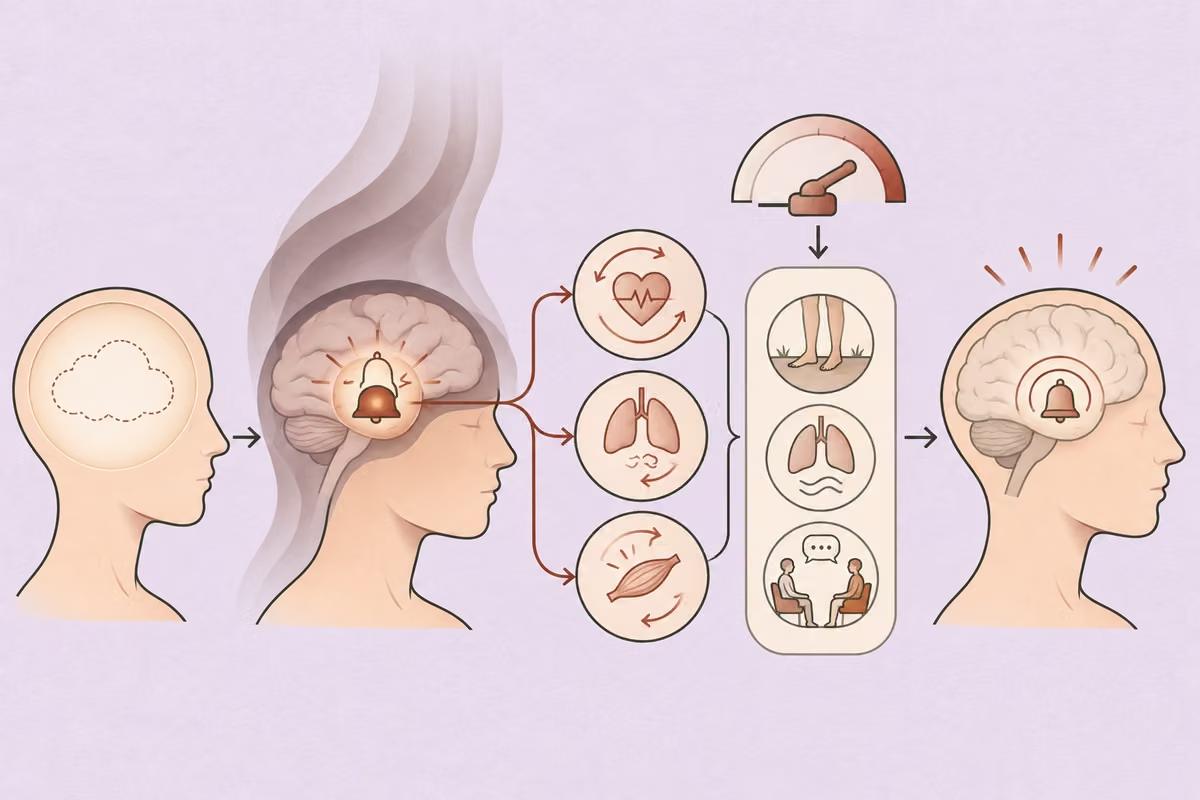
The amygdala is a small paired structure deep in the temporal lobes. It is involved in rapidly detecting significant, especially potentially dangerous, signals and in launching defensive responses: a faster pulse, tense muscles, narrowed attention.
One important detail: the amygdala reacts faster than we can consciously evaluate the situation. That is handy when you need to jump away from a car, but it also means an anxious reaction can start before you understand what triggered it.
Other systems take part in regulating anxiety too:
- the prefrontal cortex helps judge how real a threat is and put the brakes on the reaction;
- the hippocampus links the reaction to context: where and when it happens and whether it resembles a past dangerous experience;
- the autonomic nervous system turns the alarm into bodily sensations — heartbeat, trembling, a lump in the throat, nausea.
Anxiety is not a "broken amygdala" but the output of this whole network.
Like a smoke alarm that, after a real fire, starts going off every time you make toast.
Why anxiety appears when nothing is happening
The feeling of "no reason" arises because the trigger is often invisible. These are the most common sources.
Signals from the body
The brain reads the state of the body. A racing heart after coffee, lack of sleep, hunger, hormonal shifts or an oncoming cold can be interpreted as "something is wrong". Then a loop starts: sensation, anxious thought, even stronger bodily reaction. This is how panic attacks often develop.
Past experience
After a difficult or traumatic experience, the threat system can become hypersensitive. A smell, a tone of voice, a place, a time of year or a similar situation gets linked to past danger, and the brain reacts as if it were happening again — often without the person noticing the connection.
Accumulated load
Chronic stress works like background noise. When resources have been depleted for a long time, the threshold for anxiety drops: small things you used to ignore start to feel threatening.
Uncertainty
The brain struggles with situations where the outcome is unclear: waiting for test results, instability at work, world events. Sometimes anxiety "for no reason" is anxiety about things a person is trying not to think about.
When anxiety becomes a problem
Anxiety is a normal emotion. It is worth seeking help if:
- the anxiety is present most days for several weeks or longer;
- it interferes with sleep, work, study or relationships;
- you start avoiding places, people or situations to prevent it;
- you have episodes of intense fear with a pounding heart, shortness of breath, or fear of dying or losing your mind;
- you increasingly need alcohol, sedatives or other substances to calm down.
Anxiety disorders are among the most common mental disorders in the world. The World Health Organization estimates that about 301 million people lived with one in 2019. You are definitely not alone.
A medical note: a racing heart, trembling and anxiety can be linked to thyroid problems, heart rhythm disorders, anaemia or medication side effects. If symptoms appear for the first time or suddenly get worse, it makes sense to start with a medical check-up.
What actually helps
The goal is not to "switch off" emotions or the amygdala — no one survives without a threat system. The goal is to help the brain tell more accurately where danger exists now and where the reaction is driven by past experience or the state of the body.
Evidence-based approaches
- Cognitive behavioural therapy teaches you to notice and test automatic anxious thoughts and to step out of avoidance gradually.
- Exposure-based approaches let you face what you fear safely and in measured doses, so the threat system learns from experience that nothing terrible happens.
- EMDR and other methods for working with traumatic memory help when anxiety is tied to difficult past experiences. The WHO recommends EMDR for post-traumatic stress disorder.
- For severe anxiety disorders, a psychiatrist may prescribe medication, which combines well with psychotherapy.
What you can do on your own today
- Slow breathing with a longer exhale (for example, in for 4 counts, out for 6) reduces sympathetic nervous system activity.
- Regular sleep and physical activity affect anxiety more than most people expect.
- Cut back on caffeine if you notice anxiety rises after it.
- Note when and where anxiety appears. After a couple of weeks, patterns often emerge that are impossible to see from the inside.
- Do not fight anxiety with force. Trying to stop it urgently often makes it stronger. It helps more to name the state — "my anxiety has switched on" — and let it pass.
How I work with anxiety
I see anxiety as a signal from a system, not a character flaw. First we figure out what it is made of in your case: body, past experience, current circumstances, relationships, work. Then we choose methods for the task, from cognitive and exposure techniques to memory work. Sessions are online, so it does not matter which city or country you are in.
Frequently asked questions
Can anxiety really have no cause at all?
Subjectively, yes — that is how it feels. But there is usually a trigger: a bodily sensation, an association with past experience, accumulated fatigue or an unnoticed thought. Psychological work helps make those triggers visible.
Can the amygdala be "fixed"?
The amygdala does not need fixing or removing — it performs an important protective function. Psychotherapy changes how the brain evaluates signals, so over time reactions become more accurate and calmer. This is possible thanks to neuroplasticity, the brain's ability to change through experience.
How long does it take for anxiety to ease?
It depends on the cause and severity. Many people notice first changes after a few weeks of regular work. A course of CBT for anxiety disorders typically takes 8 to 20 sessions; trauma-related work may take longer.
Does online therapy work for anxiety?
Yes. Research shows that video-based psychotherapy for anxiety disorders is broadly comparable in effectiveness to in-person sessions. Many anxious people find it even easier, since there is no need to travel to an unfamiliar place.
When should I seek help urgently?
If you have thoughts of suicide or of harming yourself, do not wait for a scheduled session: contact your local emergency services or a 24/7 crisis line.
About the author
More than 15 years in psychology and working with people. Degree in psychology from HSE University, four years of training at the Moscow Gestalt Institute, specialisation in long-term therapy of personality disorders and short-term trauma therapy. I provide online support for adults.
Sources
- World Health Organization. Anxiety disorders: fact sheet, 2023.
- LeDoux J. E. Anxious: Using the Brain to Understand and Treat Fear and Anxiety, 2015.
- Clark D. M. A cognitive approach to panic. Behaviour Research and Therapy, 1986.
- World Health Organization. Guidelines for the management of conditions specifically related to stress, 2013.
This article is for educational purposes only and does not constitute medical advice, a diagnosis or a treatment recommendation. The symptoms and methods described are meant to help you understand the topic; only a doctor or qualified professional can assess your condition, make a diagnosis and recommend treatment after an individual consultation.