Postpartum Depression and Depression in Pregnancy: Signs and Help
How postpartum depression differs from the baby blues: depression in pregnancy and after birth, the Edinburgh scale, depression in fathers, warning signs of postpartum psychosis, causes and treatment.
Contents
- Baby blues or postpartum depression
- Baby blues
- Postpartum depression
- Signs of postpartum depression
- How common it is
- Depression during pregnancy
- The Edinburgh Postnatal Depression Scale
- Why postpartum depression develops
- After a caesarean section
- Depression on parental leave
- Postpartum psychosis — an emergency
- Depression in fathers
- How it is treated
- What loved ones can do
- How I can help
- Frequently asked questions
- How is postpartum depression different from the baby blues?
- When does postpartum depression start?
- How can I check myself for postpartum depression?
- Can men have postpartum depression?
- Can postpartum depression be treated while breastfeeding?
- When should I seek help urgently?
- About the author
- Sources
In short: in the first days after giving birth, most women have the "baby blues" — tearfulness, mood swings and anxiety that pass on their own within two weeks. Postpartum depression is different: it lasts longer, goes deeper and gets in the way of caring for yourself and your baby. It affects roughly one in seven or eight women and can begin during pregnancy or at any point in the first year after birth. It is not a sign of being a bad mother; it is an illness that responds well to treatment. The Edinburgh Postnatal Depression Scale is used for self-screening. Postpartum psychosis is a separate emergency: confusion, delusions or hallucinations in the first weeks after birth require urgent help.
Baby blues or postpartum depression
Baby blues
- Affects most women — by various estimates, up to 50–80%.
- Begins in the first days after birth.
- Tearfulness, mood swings, irritability, anxiety, a sense of vulnerability.
- Passes on its own within two weeks.
- Rest, support and help with the baby make a difference.
Postpartum depression
- Lasts longer than two weeks.
- The symptoms go deeper and get in the way of caring for yourself and your baby.
- Can begin at any point in the first year after birth.
- Requires professional help.
Signs of postpartum depression
- Low mood, emptiness, tearfulness for most of the day.
- Loss of interest and joy, including in time with the baby.
- Feeling detached from the baby or, conversely, constant worry about them.
- Guilt, a sense of being a bad mother.
- Severe anxiety, panic attacks.
- Intrusive frightening thoughts that something bad might happen to the baby.
- Disturbed sleep — being unable to fall asleep even when the baby is sleeping.
- Changes in appetite.
- Exhaustion that is not explained by lack of sleep alone.
- Irritability and outbursts of anger.
- Thoughts that your family would be better off without you, thoughts of death.
Frightening intrusive thoughts about harm coming to the baby are very common in postpartum anxiety and depression. On their own they usually do not mean that the mother will cause harm — on the contrary, they horrify her. But it is important to tell a professional about them.
How common it is
- According to a 2018 meta-analysis by Shefaly Shorey and colleagues, postpartum depression affects about 17% of women worldwide, although estimates vary between countries.
- Depression during pregnancy is at least as common.
Depression during pregnancy
Depression can begin during pregnancy. The American classification DSM-5 describes depression with peripartum onset — during pregnancy or in the first four weeks after birth — although in practice doctors take the whole first year into account. Depression in pregnancy raises the risk of postpartum depression, so it is important to recognise and treat it.
The Edinburgh Postnatal Depression Scale
The scale was developed by John Cox, Jenifer Holden and Ruth Sagovsky in 1987.
- 10 questions about how you have felt over the past seven days.
- Completed by the woman herself.
- Suitable both during pregnancy and after birth.
- A score of 10 or more suggests possible depression; 13 or more, a high likelihood.
- Any answer other than "never" to the question about thoughts of self-harm is a reason to seek help urgently.
You can complete the scale with your obstetrician, midwife, health visitor, paediatrician or therapist.
Why postpartum depression develops
- A sharp drop in oestrogen and progesterone after birth. Some women's brains are especially sensitive to these changes.
- Past depression or anxiety, including during pregnancy.
- Depression after a previous birth.
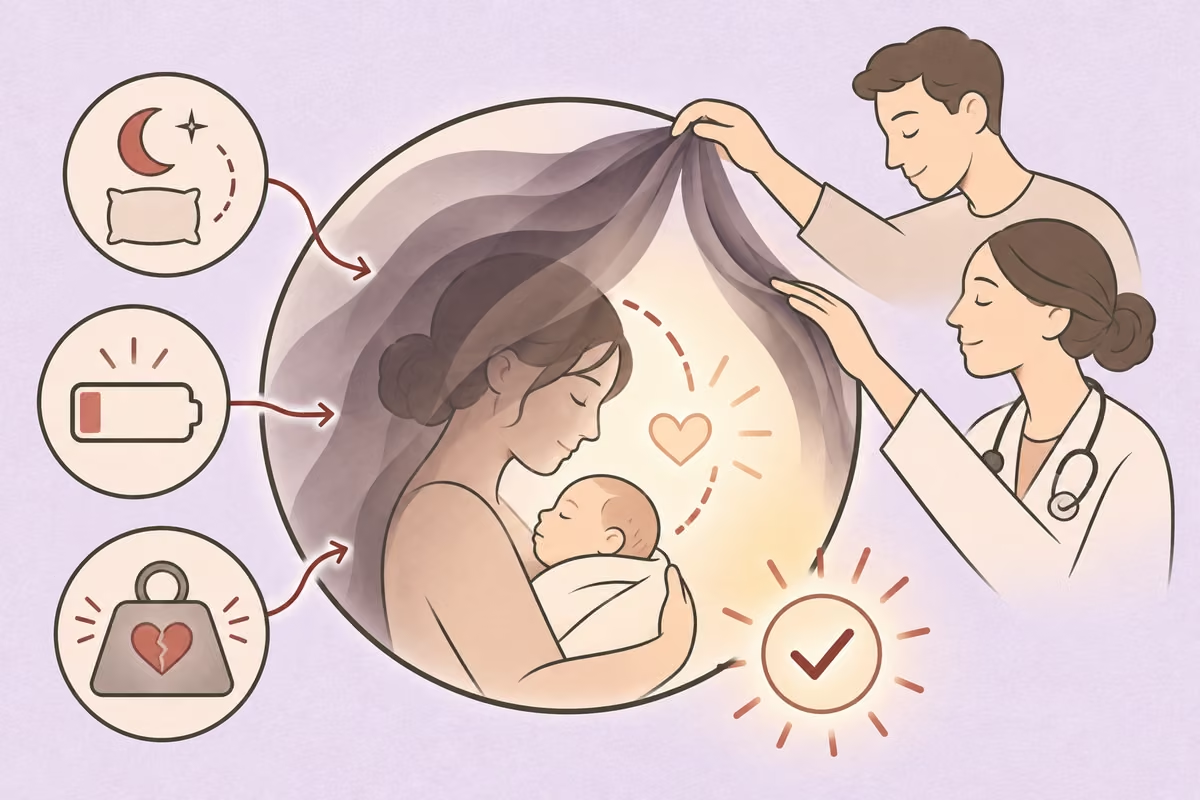
- Chronic sleep deprivation and exhaustion.
- A difficult or traumatic birth.
- Lack of support, loneliness, conflict with a partner.
- Financial difficulties, housing problems.
- Difficulties with breastfeeding.
- A baby who is ill or premature.
- Thyroid problems after birth — see "Depression and Physical Illness".
After a caesarean section
A caesarean section, especially an emergency one, can be experienced as traumatic: fear, a sense of losing control, disappointment that the birth did not go as planned. Recovering from surgery, pain and physical limits add to the burden. Some studies link emergency caesarean sections to a slightly higher risk of postpartum depression. It is important to talk about your feelings and not be ashamed of them.
Depression on parental leave
Even if there was no depression right after birth, it can develop later, during parental leave. It is fuelled by isolation, monotony, chronic tiredness, the loss of former roles and social contact, and a sense that life has "stopped". If low mood lasts two weeks or longer, it is a reason to see a professional rather than to "just put up with it".
Postpartum psychosis — an emergency
- Occurs in about one or two women per thousand births.
- Usually begins in the first two weeks after birth.
- Signs: confusion, sharp mood swings, agitation, insomnia, delusions, hallucinations, strange behaviour.
- The risk is higher in women with bipolar disorder or previous postpartum psychosis — see "Bipolar Depression".
- This is an emergency that puts the lives of mother and baby at risk. Contact your local emergency services or see a psychiatrist urgently.
Depression in fathers
According to a 2010 meta-analysis by James Paulson and Sharnail Bazemore, about 10% of fathers develop depression during their partner's pregnancy or in the first year after birth. It often shows up as irritability, withdrawing into work and drinking. Depression in one parent raises the risk of depression in the other. More in "Depression in Women, Men and Older Adults".
How it is treated
- Psychotherapy — cognitive behavioural and interpersonal therapy are effective for postpartum depression.
- Medication — for moderate and severe depression. Many medicines are compatible with breastfeeding, but only a doctor should choose them, taking pregnancy and breastfeeding into account.
- Support — help with the baby, a chance to sleep, support groups for mothers.
- For severe depression and psychosis — hospital treatment.
More in "Depression Treatment".
What loved ones can do
- Take on part of the baby's care, especially at night, so the mother can sleep.
- Help with the household: meals, cleaning, shopping.
- Listen without judging and avoid saying "everyone goes through this" or "you should be happy".
- Help her see a professional.
- Watch for warning signs, and in case of psychosis or thoughts of self-harm, contact your local emergency services.
More in "How to Help Someone with Depression".
How I can help
In online support for adults, I help women during pregnancy and after birth cope with depression, anxiety, guilt, the experience of a difficult birth and changing roles. The online format is convenient when it is hard to leave home with a small baby. When symptoms are marked, I recommend seeing a psychiatrist at the same time.
Frequently asked questions
How is postpartum depression different from the baby blues?
The baby blues affect most women, begin in the first days after birth and pass on their own within two weeks. Postpartum depression lasts longer, goes deeper and gets in the way of caring for yourself and your baby. It requires professional help.
When does postpartum depression start?
It can begin during pregnancy or at any point in the first year after birth. Most often it starts in the first weeks and months.
How can I check myself for postpartum depression?
The 10-question Edinburgh Postnatal Depression Scale is used for self-screening. A score of 10 or more is a reason to see a professional. You can complete it with your obstetrician, midwife, paediatrician or therapist.
Can men have postpartum depression?
Yes. About 10% of fathers develop depression during their partner's pregnancy or in the first year after birth. It often shows up as irritability, withdrawing into work and drinking.
Can postpartum depression be treated while breastfeeding?
Yes. Psychotherapy is safe, and many medicines are compatible with breastfeeding. Only a doctor should choose the medicine, taking breastfeeding into account.
When should I seek help urgently?
If there are signs of postpartum psychosis, thoughts of suicide or of harming yourself or the baby, do not wait: contact your local emergency services or a 24/7 crisis line.
About the author
More than 15 years in psychology and working with people. Degree in psychology from HSE University, four years of training at the Moscow Gestalt Institute, specialisation in long-term therapy of personality disorders and short-term trauma therapy. I provide online support for adults.
Sources
- Stewart D. E., Vigod S. N. Postpartum depression: pathophysiology, treatment, and emerging therapeutics. Annual Review of Medicine, 2019.
- Shorey S. et al. Prevalence and incidence of postpartum depression among healthy mothers: a systematic review and meta-analysis. Journal of Psychiatric Research, 2018.
- Cox J. L., Holden J. M., Sagovsky R. Detection of postnatal depression: development of the 10-item Edinburgh Postnatal Depression Scale. British Journal of Psychiatry, 1987.
- Paulson J. F., Bazemore S. D. Prenatal and postpartum depression in fathers and its association with maternal depression: a meta-analysis. JAMA, 2010.
- Bergink V., Rasgon N., Wisner K. L. Postpartum psychosis: madness, mania, and melancholia in motherhood. American Journal of Psychiatry, 2016.
- National Institute for Health and Care Excellence. Antenatal and postnatal mental health: clinical management and service guidance (CG192). 2014, updated 2020.
This article is for educational purposes only and does not constitute medical advice, a diagnosis or a treatment recommendation. The symptoms and methods described are meant to help you understand the topic; only a doctor or qualified professional can assess your condition, make a diagnosis and recommend treatment after an individual consultation.