Causes of Depression: Where It Comes From and Why It Starts
Why depression develops: genetics, the brain, the stress system, inflammation, childhood experience, thinking and living conditions — and the truth about the "serotonin deficiency" idea.
Contents
- The vulnerability–stress model
- Genetics
- The brain
- What is known about serotonin
- Neuroplasticity
- Brain networks
- The stress system
- Inflammation
- Childhood experience
- Stressful events
- Thinking
- Personality traits
- Lifestyle and living conditions
- Physical illness and medication
- Endogenous and reactive depression
- Why the causes matter
- How I can help
- Frequently asked questions
- Why does depression happen?
- Is depression hereditary?
- Is depression really a lack of serotonin?
- What is endogenous depression?
- Can depression start for no reason?
- When should I seek help urgently?
- About the author
- Sources
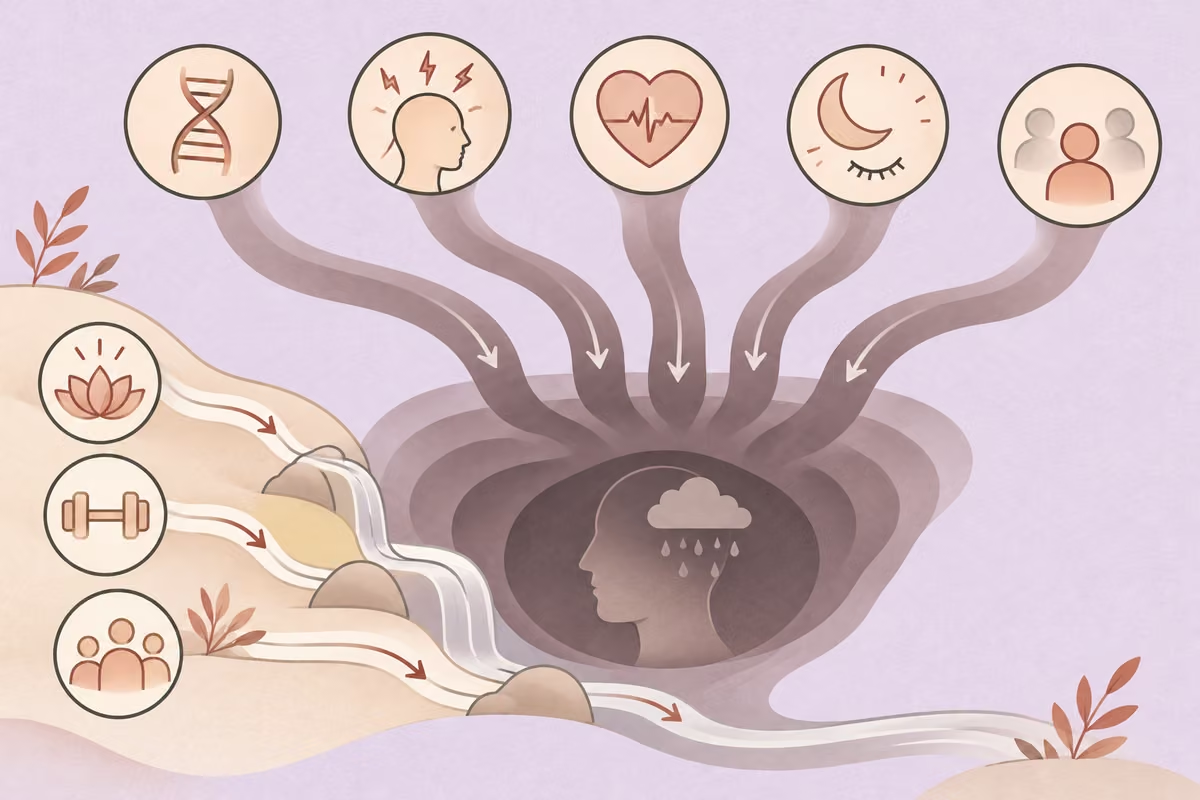
In short: depression has no single cause. It develops when several factors come together: inherited vulnerability, the way the brain and stress system work, difficult childhood experiences, chronic stress or serious losses, thinking patterns, physical illness, lack of sleep, loneliness, poverty. Scientists describe this with the "vulnerability–stress" model: the higher the vulnerability, the less stress it takes to trigger depression. The popular explanation "depression is a lack of serotonin" is now considered too simplistic. The division into endogenous and reactive depression is not used in modern classifications, although it is still heard in everyday speech.
The vulnerability–stress model
Imagine a set of scales. On one side is vulnerability: genes, early experience, personality traits, illness. On the other is load: stress, losses, conflicts, overload. Depression begins when the load exceeds a person's resources. That is why some people go through severe hardship without depression, while others develop it after seemingly minor events.
Genetics
- According to a 2000 meta-analysis of twin studies by Patrick Sullivan and colleagues, the heritability of major depression is about 37%. This means genes matter, but most of the risk comes from other factors.
- If a close relative has had depression, your risk is roughly two to three times higher.
- There is no "depression gene". A large 2019 genetic study by David Howard and colleagues found more than a hundred gene variants, each of which raises the risk only slightly.
- A hypothesis popular in the 2000s — that a single variant of the serotonin transporter gene sharply raises the risk of depression after stress — was not confirmed in large later studies.
What is inherited is not depression itself but a predisposition to it. Under favourable conditions, it may never show up.
The brain
What is known about serotonin
For a long time depression was explained as a "lack of serotonin". In 2022, Joanna Moncrieff and colleagues published a review of the research and found no convincing evidence that people with depression simply have lower serotonin levels. This does not mean that serotonin plays no part in depression or that antidepressants do not work: their effectiveness has been shown in clinical trials. It means that depression is more complex than a shortage of one substance.
Neuroplasticity
Modern theories emphasise the brain's ability to change and form new connections. In chronic stress and depression this ability is reduced in some areas — for example, in the hippocampus, which is involved in memory and stress regulation, and in the prefrontal cortex, which is responsible for controlling emotions. Many treatments appear to work in part by restoring neuroplasticity.
Brain networks
Neuroimaging studies show changes in the networks responsible for emotion, reward and self-reflection. For example, in people with depression the network linked to thinking about oneself is often overactive, which may be connected with rumination.
The stress system
Under stress, the hypothalamic–pituitary–adrenal system switches on and the adrenal glands release cortisol. Normally the system calms down once the stress is over. In chronic stress, and in many people with depression, it stays overactive and cortisol levels remain high. This affects sleep, appetite, immunity and brain function.
Inflammation
Some people with depression have raised markers of inflammation in their blood. Inflammatory substances affect the brain and can cause low mood, fatigue and loss of interest. The link between depression and physical health is covered in "Depression and Physical Illness".
Childhood experience
- Abuse, neglect, losing a parent, or living with a parent who has an addiction or mental disorder significantly increase the risk of depression in adulthood.
- The 1998 Adverse Childhood Experiences study by Vincent Felitti and colleagues showed that the more such events a person had in childhood, the higher their risk of depression and other health problems.
- Early stress affects how the stress system develops and how a person comes to see themselves and others.
Stressful events
Depression is often preceded by major events: the death of a loved one, divorce, losing a job, financial difficulties, illness, moving, conflicts. Research by Kenneth Kendler and colleagues showed that the risk of depression rises especially after events involving loss and humiliation.
Thinking
Aaron Beck described how people prone to depression often hold deep negative beliefs about themselves: "I'm a failure", "I'm unlovable". Under stress these beliefs are activated and colour perception. A tendency to ruminate — endlessly going over dark thoughts — also raises the risk of depression and makes it last longer, as the American psychologist Susan Nolen-Hoeksema showed.
Personality traits
High neuroticism — a tendency to experience negative emotions intensely — perfectionism and strong self-criticism raise the risk of depression.
Lifestyle and living conditions
- Chronic lack of sleep.
- Physical inactivity.
- Loneliness and social isolation.
- Poverty, unemployment, poor housing.
- Chronic overload at work and at home.
- Misuse of alcohol and other substances — see "Depression, Anxiety and Addiction".
Physical illness and medication
Depression can be caused or worsened by thyroid disease, diabetes, heart disease, chronic pain, neurological conditions and some medications. More in "Depression and Physical Illness".
Endogenous and reactive depression
- "Endogenous" depression was the term for depression that arises "from within", without an obvious external trigger, and was linked to biological causes.
- "Reactive", or psychogenic, depression was the term for depression that arises in response to a hard event.
Today this division is not used in international classifications. Research has shown that the line between them is blurred: most depressions have both a biological and a psychological component, and external events occur in "endogenous" depression too. However, depression with melancholic features is still recognised, and it is the closest to the old idea of endogenous depression: a marked loss of the ability to feel pleasure, worse mood in the mornings, early waking and noticeable slowing down. More in "Types of Depression".
Why the causes matter
Understanding the causes helps you:
- stop blaming yourself: depression is not a weakness or a choice;
- see what you can influence: sleep, workload, relationships, thinking;
- choose treatment: psychotherapy, medication, lifestyle changes, treating physical illness — see "Depression Treatment".
How I can help
In online support for adults, we look together at what triggered the depression and what keeps it going: stress, losses, relationships, habitual ways of thinking about yourself. Working with these helps not only to recover from depression but also to reduce the risk of it coming back.
Frequently asked questions
Why does depression happen?
Depression develops through a combination of factors: inherited vulnerability, the way the brain and stress system work, difficult experiences, chronic stress, illness and living conditions. There is usually no single cause.
Is depression hereditary?
What is inherited is a predisposition, not depression itself. Heritability is estimated at about 37%. If close relatives have had depression, the risk is higher, but under favourable conditions it may never develop.
Is depression really a lack of serotonin?
That is an oversimplification. A 2022 review of the research found no convincing evidence of a simple drop in serotonin in depression. Serotonin is involved in regulating mood, but depression is linked to many processes in the brain and body.
What is endogenous depression?
This was the term for depression that arises without an obvious external trigger and is linked to biological causes. Modern classifications no longer use it; the closest current concept is depression with melancholic features.
Can depression start for no reason?
Sometimes depression begins without any noticeable external event. But that does not mean there are no causes: they may lie in genetics, brain function, accumulated stress, illness or seasonal changes — see "Autumn and Seasonal Depression".
When should I seek help urgently?
If you have thoughts of suicide or of harming yourself, do not wait for a scheduled appointment: contact your local emergency services or a 24/7 crisis line.
About the author
More than 15 years in psychology and working with people. Degree in psychology from HSE University, four years of training at the Moscow Gestalt Institute, specialisation in long-term therapy of personality disorders and short-term trauma therapy. I provide online support for adults.
Sources
- Sullivan P. F., Neale M. C., Kendler K. S. Genetic epidemiology of major depression: review and meta-analysis. American Journal of Psychiatry, 2000.
- Howard D. M. et al. Genome-wide meta-analysis of depression identifies 102 independent variants and highlights the importance of the prefrontal brain regions. Nature Neuroscience, 2019.
- Border R. et al. No support for historical candidate gene or candidate gene-by-interaction hypotheses for major depression across multiple large samples. American Journal of Psychiatry, 2019.
- Moncrieff J. et al. The serotonin theory of depression: a systematic umbrella review of the evidence. Molecular Psychiatry, 2022.
- Felitti V. J. et al. Relationship of childhood abuse and household dysfunction to many of the leading causes of death in adults. American Journal of Preventive Medicine, 1998.
- Kendler K. S. et al. Life event dimensions of loss, humiliation, entrapment, and danger in the prediction of onsets of major depression and generalized anxiety. Archives of General Psychiatry, 2003.
- Nolen-Hoeksema S. The role of rumination in depressive disorders and mixed anxiety/depressive symptoms. Journal of Abnormal Psychology, 2000.
- Malhi G. S., Mann J. J. Depression. The Lancet, 2018.
This article is for educational purposes only and does not constitute medical advice, a diagnosis or a treatment recommendation. The symptoms and methods described are meant to help you understand the topic; only a doctor or qualified professional can assess your condition, make a diagnosis and recommend treatment after an individual consultation.