Autumn and Seasonal Depression: Why Mood Darkens and What Helps
Winter blues or seasonal depression? Why mood drops and sleepiness grows in autumn and winter, what seasonal affective disorder is, how light therapy works and whether summer depression exists.
Contents
- Winter blues or depression
- Winter blues
- Seasonal depression
- Signs of seasonal depression
- Why it happens
- Who is at risk
- Light therapy
- Cognitive behavioural therapy
- What else helps
- Medication and vitamin D
- Summer depression
- Low mood before birthdays and on holiday
- How I can help
- Frequently asked questions
- Why does mood drop in autumn?
- What is seasonal depression?
- Does a light lamp help with depression?
- How can I tell the winter blues from depression?
- Is there such a thing as summer depression?
- When should I seek help urgently?
- About the author
- Sources
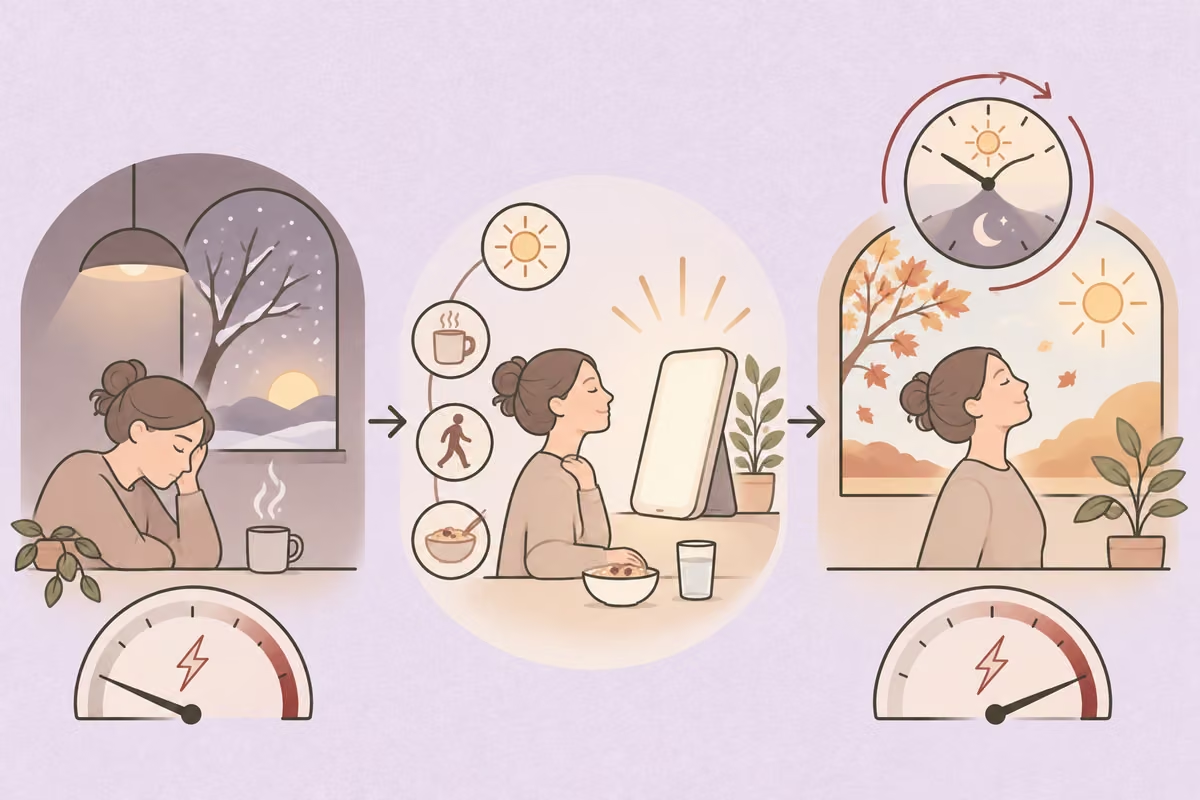
In short: in autumn and winter many people have less energy, feel sleepier, crave sweets and feel low. In a mild form this is called the winter blues. When the changes reach the level of depression and return year after year at the same time, it is called seasonal affective disorder, or depression with a seasonal pattern. The main cause is a lack of light: short days throw the body clock off and affect the systems that regulate mood and sleep. Seasonal depression responds well to treatment: light therapy and cognitive behavioural therapy have proven effectiveness, and a doctor may prescribe medication if needed.
Winter blues or depression
Winter blues
- A mild drop in mood and energy in autumn and winter.
- You want to sleep more and eat more sweets.
- You keep living, working and enjoying things as usual.
Seasonal depression
- Symptoms of depression: low mood, loss of interest, fatigue, difficulty concentrating, guilt.
- They get in the way of work, study and social life.
- They start at about the same time each year — usually in autumn or early winter — and pass in spring.
- They recur for at least two years in a row.
Signs of seasonal depression
Winter seasonal depression often looks like atypical depression:
- increased sleepiness, long sleep, difficulty waking up in the morning;
- increased appetite, especially craving for sweets and starchy foods;
- weight gain;
- heaviness in the body, low energy;
- wanting to "hibernate", withdrawing from people;
- low mood, irritability;
- difficulty concentrating.
How seasonal depression fits among other forms is explained in "Types of Depression".
Why it happens
- Lack of light. In 1984, Norman Rosenthal and colleagues described seasonal affective disorder and showed that bright light relieves its symptoms.
- A disrupted body clock. Morning light is the main signal that sets circadian rhythms. When mornings are dark, the rhythms shift.
- Melatonin. In the dark it is produced for longer, which can increase sleepiness.
- Serotonin. There is evidence that the activity of the serotonin system changes with the seasons.
- Genetics and individual sensitivity to light.
Who is at risk
- People living at northern latitudes with short winter days.
- Women — they are affected more often.
- Young people.
- People who have had depression or bipolar disorder in the past.
- People whose relatives have seasonal depression.
Light therapy
Light therapy is the main treatment for winter seasonal depression. A 2005 meta-analysis by Robert Golden and colleagues confirmed its effectiveness.
- Special light therapy lamps are used that give bright diffuse light — usually 10,000 lux — and do not emit ultraviolet.
- A session lasts about 20–30 minutes in the morning, soon after waking up.
- The lamp is placed at a set distance from the face; you do not need to look straight at it — you can read, have breakfast or work.
- Improvement is usually noticeable after one to two weeks.
- The course continues throughout the dark season.
Important:
- Talk to a doctor before starting light therapy, especially if you have eye conditions, are sensitive to light or take medication that increases light sensitivity.
- In bipolar disorder, light therapy can trigger hypomania, so it is used only under medical supervision. More in "Bipolar Depression".
- Ordinary lamps and tanning lamps are not suitable.
Cognitive behavioural therapy
A special version of cognitive behavioural therapy for seasonal depression works with negative attitudes towards winter, avoidance and reduced activity. In a 2015 study by Kelly Rohan and colleagues, it was as effective as light therapy during the first winter, and more effective at preventing repeat episodes the following winter.
What else helps
- Going outside in daylight, especially in the morning. Even on a cloudy day it is much brighter outdoors than indoors.
- Keeping your desk by a window.
- Making your home brightly lit in the morning.
- Keeping a regular sleep schedule — getting up at the same time every day.
- Moving, preferably outdoors.
- Planning enjoyable activities for the winter — behavioural activation. More in "How to Get Out of Depression on Your Own".
- Staying in touch with people.
- If possible, a winter holiday somewhere sunny.
Medication and vitamin D
- For marked seasonal depression, a doctor may prescribe antidepressants, including as prevention before the dark season begins. More in "Depression Treatment".
- There is not enough evidence that taking vitamin D on its own treats seasonal depression. It is best to discuss testing and taking vitamin D with a doctor.
Summer depression
Less often, the pattern is reversed — depression in spring and summer. It is more often accompanied by insomnia, reduced appetite, weight loss, anxiety and restlessness. It is linked to heat, bright light and disrupted sleep. Treatment is chosen by a doctor.
Low mood before birthdays and on holiday
- Many people notice low mood before their birthday or New Year: these dates push us to take stock and compare expectations with reality. It usually passes on its own.
- Holidays sometimes make things worse rather than better: without familiar routines, tiredness, anxiety and unresolved problems come to the surface.
If low mood lasts two weeks or longer, it is a reason to see a professional, whatever the trigger.
How I can help
In online support for adults, I help people with seasonal depression build a "winter plan": routine, activity, and work with avoidance and negative thoughts about the dark season. When symptoms are marked, I recommend discussing light therapy and medication with a doctor.
Frequently asked questions
Why does mood drop in autumn?
Short days throw the body clock off and affect the systems that regulate sleep and mood. For many people this causes mild winter blues, and for some, seasonal depression.
What is seasonal depression?
It is depression that returns year after year at the same time — usually in autumn and winter — and passes in spring. It is often accompanied by sleepiness, increased appetite and craving for sweets.
Does a light lamp help with depression?
For winter seasonal depression, light therapy with a special lamp of about 10,000 lux for 20–30 minutes in the morning has proven effectiveness. It is worth talking to a doctor before starting, especially if you have eye conditions or bipolar disorder.
How can I tell the winter blues from depression?
With the blues, a person keeps living normally and enjoying things, even if they feel less like doing them. With seasonal depression, low mood, loss of interest and fatigue get in the way of work and social life.
Is there such a thing as summer depression?
Yes, but it is less common than winter depression. Summer depression is more often accompanied by insomnia, reduced appetite and anxiety. Treatment is chosen by a doctor.
When should I seek help urgently?
If you have thoughts of suicide or of harming yourself, do not wait for a scheduled appointment: contact your local emergency services or a 24/7 crisis line.
About the author
More than 15 years in psychology and working with people. Degree in psychology from HSE University, four years of training at the Moscow Gestalt Institute, specialisation in long-term therapy of personality disorders and short-term trauma therapy. I provide online support for adults.
Sources
- Rosenthal N. E. et al. Seasonal affective disorder: a description of the syndrome and preliminary findings with light therapy. Archives of General Psychiatry, 1984.
- Golden R. N. et al. The efficacy of light therapy in the treatment of mood disorders: a review and meta-analysis of the evidence. American Journal of Psychiatry, 2005.
- Rohan K. J. et al. A randomized controlled trial of cognitive-behavioral therapy versus light therapy for seasonal affective disorder: acute outcomes. American Journal of Psychiatry, 2015.
- Rohan K. J. et al. Outcomes one and two winters following cognitive-behavioral therapy or light therapy for seasonal affective disorder. American Journal of Psychiatry, 2016.
- Pjrek E. et al. The efficacy of light therapy in the treatment of seasonal affective disorder: a meta-analysis of randomized controlled trials. Psychotherapy and Psychosomatics, 2020.
- Wirz-Justice A., Benedetti F., Terman M. Chronotherapeutics for Affective Disorders. Karger, 2013.
This article is for educational purposes only and does not constitute medical advice, a diagnosis or a treatment recommendation. The symptoms and methods described are meant to help you understand the topic; only a doctor or qualified professional can assess your condition, make a diagnosis and recommend treatment after an individual consultation.