Is Depression Dangerous? Suicide Risk and When to Get Urgent Help
Why depression is dangerous and whether you can die from it: suicide risk and physical health, warning signs, why talking about thoughts of death matters, safety plans and where to turn right now.
Contents
- Why depression is dangerous
- Can you die from depression?
- Signs of increased risk
- Periods of special risk
- If you are having thoughts of death
- Safety plan
- If you are worried about someone close to you
- Where to turn
- How I can help
- Frequently asked questions
- Why is depression dangerous?
- Can you die from depression?
- Is it normal to think about death when depressed?
- Is it okay to ask someone about suicidal thoughts?
- Who should I contact if I feel bad right now?
- About the author
- Sources
If you are feeling very bad right now and thinking about harming yourself, contact your local emergency services or go to the nearest hospital. To find a free crisis line, search online for "crisis line" or "suicide prevention helpline" together with the name of your country. You do not have to cope with this alone.
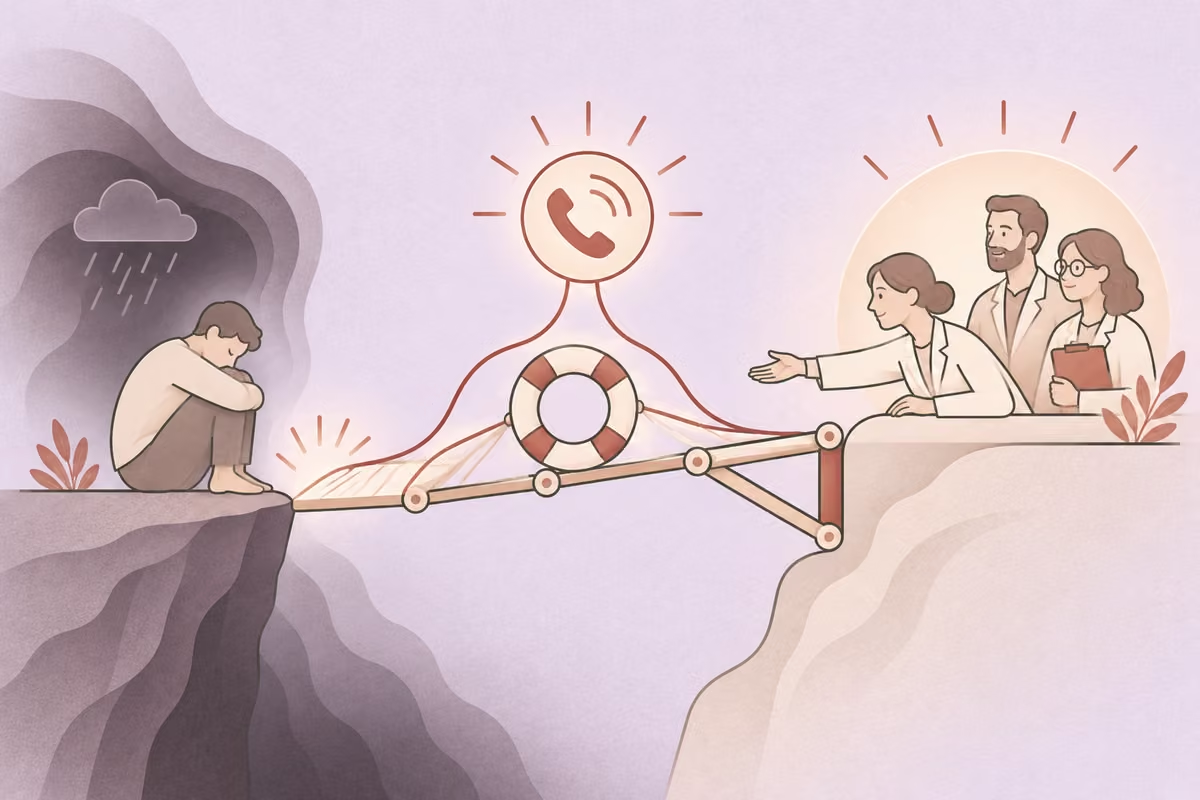
In short: depression is a serious illness, and its main danger is the risk of suicide. Depression is one of the most important risk factors for suicide, although most people with depression never make an attempt. In addition, long-lasting depression raises the risk of heart disease, diabetes and other health problems. Thoughts of death in depression are a symptom of the illness, not the truth about your life, and they pass with treatment. It is important to talk about them: research shows that asking directly about suicidal thoughts does not increase the risk but helps the person get help.
Why depression is dangerous
- Suicide risk. Depression distorts perception: the future seems hopeless and the person feels like a burden to others. At the peak of hopelessness it can seem that there is no way out.
- Effects on the body. Long-lasting depression is linked to a higher risk of cardiovascular disease, diabetes, weakened immunity and chronic pain — see "Depression and Physical Illness".
- Neglecting self-care. In severe depression a person may stop eating, stop taking necessary medication, stop seeing doctors.
- Addiction. Many people try to numb their state with alcohol, which worsens both depression and suicide risk — see "Depression, Anxiety and Addiction".
- Damage to life. Loss of work, relationships and social ties.
Can you die from depression?
Depression itself does not kill the way a heart attack does. But it raises the risk of death — above all through suicide, and also through physical illness and neglect of self-care. Timely treatment significantly reduces these risks.
Signs of increased risk
Pay attention if a person:
- talks about death, about wanting to die, about everyone being "better off without me", about being a burden;
- talks about hopelessness: "nothing will change", "there's no way out";
- says goodbye, gives away belongings, puts their affairs in order;
- looks for ways to harm themselves;
- suddenly withdraws from people;
- starts drinking more or using other substances;
- shows sudden calm after a long depression — sometimes this means the person has made a decision;
- has made attempts in the past.
The risk is also raised by severe depression, psychotic symptoms, strong anxiety and agitation, insomnia, chronic pain, recent losses, loneliness and access to dangerous means.
Periods of special risk
- The start of treatment. Energy sometimes returns before mood improves. That is why medical supervision matters in the first weeks of treatment.
- After discharge from hospital.
- After hard events: loss, divorce, losing a job, humiliation.
- In teenagers and young people. More in "Depression in Children and Teens".
If you are having thoughts of death
- Remember that this is a symptom of depression. It passes with treatment.
- Tell someone: a person close to you, a doctor, a therapist, a crisis line.
- Remove anything you could use to hurt yourself, or ask someone close to you to do it.
- Do not stay alone in difficult moments.
- Stop drinking alcohol and using other substances.
- If the thoughts become persistent, or you have a plan or intention, contact your local emergency services or go to the nearest hospital.
Safety plan
The safety plan was developed by American psychologists Barbara Stanley and Gregory Brown. It is made in advance, with a professional or on your own, and kept close at hand.
- My warning signs — the thoughts, feelings and situations that come before a crisis.
- What I can do on my own to distract and calm myself.
- People and places that help me take my mind off things.
- People I can ask for help — with their phone numbers.
- Professionals and services I can call — with their phone numbers.
- How to make my surroundings safer.
- What makes my life worth living.
If you are worried about someone close to you
- Ask directly: "Are you thinking about suicide?" This will not push the person towards an attempt; it shows them that their pain can be talked about.
- Listen without judging or arguing. Do not say "don't think about it" or "others have it worse".
- Do not promise to keep it secret if there is danger.
- Help them reach a professional — find contacts, offer to go together.
- If the danger is immediate, do not leave the person alone and contact your local emergency services.
More in "How to Help Someone with Depression".
Where to turn
- Your local emergency services — when there is immediate danger.
- The nearest hospital or psychiatric service — in an acute crisis.
- A crisis line — search online for "crisis line" or "suicide prevention helpline" together with the name of your country. For children and teenagers, search for "youth helpline" or "child helpline" and the name of your country.
- A psychiatrist or psychotherapist — for treating depression. More in "Depression Treatment".
How I can help
In online support for adults, I work with people going through severe depressive states, help them build a safety plan and find something to hold on to. When the risk of suicide is high, online psychotherapy is not enough: in that case I help the person get in-person psychiatric care as quickly as possible.
Frequently asked questions
Why is depression dangerous?
The main danger of depression is the risk of suicide. In addition, long-lasting depression raises the risk of heart disease, diabetes, chronic pain and addiction, and damages relationships and work. Timely treatment significantly reduces these risks.
Can you die from depression?
Depression does not kill directly, but it raises the risk of death — above all through suicide, and also through physical illness and neglect of self-care. Treatment reduces these risks.
Is it normal to think about death when depressed?
Thoughts of death are a common symptom of depression, and you are not alone in having them. But they are a reason to seek help as soon as possible. With treatment, these thoughts pass.
Is it okay to ask someone about suicidal thoughts?
Yes. Research shows that asking directly does not increase the risk; it helps the person feel that their pain can be talked about and helps them get support.
Who should I contact if I feel bad right now?
Your local emergency services if there is immediate danger. To talk to someone, contact a crisis line: search online for "crisis line" or "suicide prevention helpline" together with the name of your country.
About the author
More than 15 years in psychology and working with people. Degree in psychology from HSE University, four years of training at the Moscow Gestalt Institute, specialisation in long-term therapy of personality disorders and short-term trauma therapy. I provide online support for adults.
Sources
- World Health Organization. Suicide. Fact sheet, 2024.
- World Health Organization. Preventing suicide: a resource for media professionals. Update 2023.
- Stanley B., Brown G. K. Safety Planning Intervention: a brief intervention to mitigate suicide risk. Cognitive and Behavioral Practice, 2012.
- Dazzi T. et al. Does asking about suicide and related behaviours induce suicidal ideation? What is the evidence? Psychological Medicine, 2014.
- Hawton K. et al. Risk factors for suicide in individuals with depression: a systematic review. Journal of Affective Disorders, 2013.
- Cuijpers P., Smit F. Excess mortality in depression: a meta-analysis of community studies. Journal of Affective Disorders, 2002.
- National Institute for Health and Care Excellence. Self-harm: assessment, management and preventing recurrence (NG225). 2022.
This article is for educational purposes only and does not constitute medical advice, a diagnosis or a treatment recommendation. The symptoms and methods described are meant to help you understand the topic; only a doctor or qualified professional can assess your condition, make a diagnosis and recommend treatment after an individual consultation.