Psychology
Why Couples Fight Over Small Things: Repeating Patterns and How to Break Them
Fights about the dishes are almost never about the dishes. What lies behind recurring conflicts, what research on couples shows, and what helps partners reach agreement.
Contents
- Why a small thing triggers such a strong reaction
- Repeating patterns in couples
- Pursue and withdraw
- Four destructive patterns
- Perpetual problems
- What happens in the body during a fight
- How to break a repeating pattern
- 1. Name the cycle instead of blaming your partner
- 2. Start gently
- 3. Talk about what lies beneath the trigger
- 4. Listen to understand, not to reply
- 5. Notice repair attempts
- 6. Invest in closeness outside conflict
- When to see a psychologist
- How I work with relationships
- Frequently asked questions
- Is it normal for couples to fight?
- Why do we keep fighting about the same thing?
- Can a relationship change if my partner won't see a psychologist?
- How do we stop fighting?
- Sources
In short: fights over small things are almost never about small things. An unwashed mug, being late or a forgotten call becomes the trigger, while the real subject lies deeper: "I don't matter to you", "I can't rely on you", "I'm not respected". Couples get stuck not because they disagree — everyone does — but because they replay the same script over and over. That script can be noticed, named and changed.
Why a small thing triggers such a strong reaction
The intensity of emotion in a fight shows how significant the hidden meaning of the situation is. When a partner fails to reply to a message for the third time in a week, the hurt may not be about the message but about the fear of not mattering. The brain reacts not to the event but to its interpretation, and that interpretation often draws on past experience — from childhood or previous relationships.
Accumulation adds to this. When small grievances go undiscussed for a long time, every new event lands on already charged ground. From the outside it looks like "exploding over nothing"; from the inside it is the last straw.
Repeating patterns in couples
Pursue and withdraw
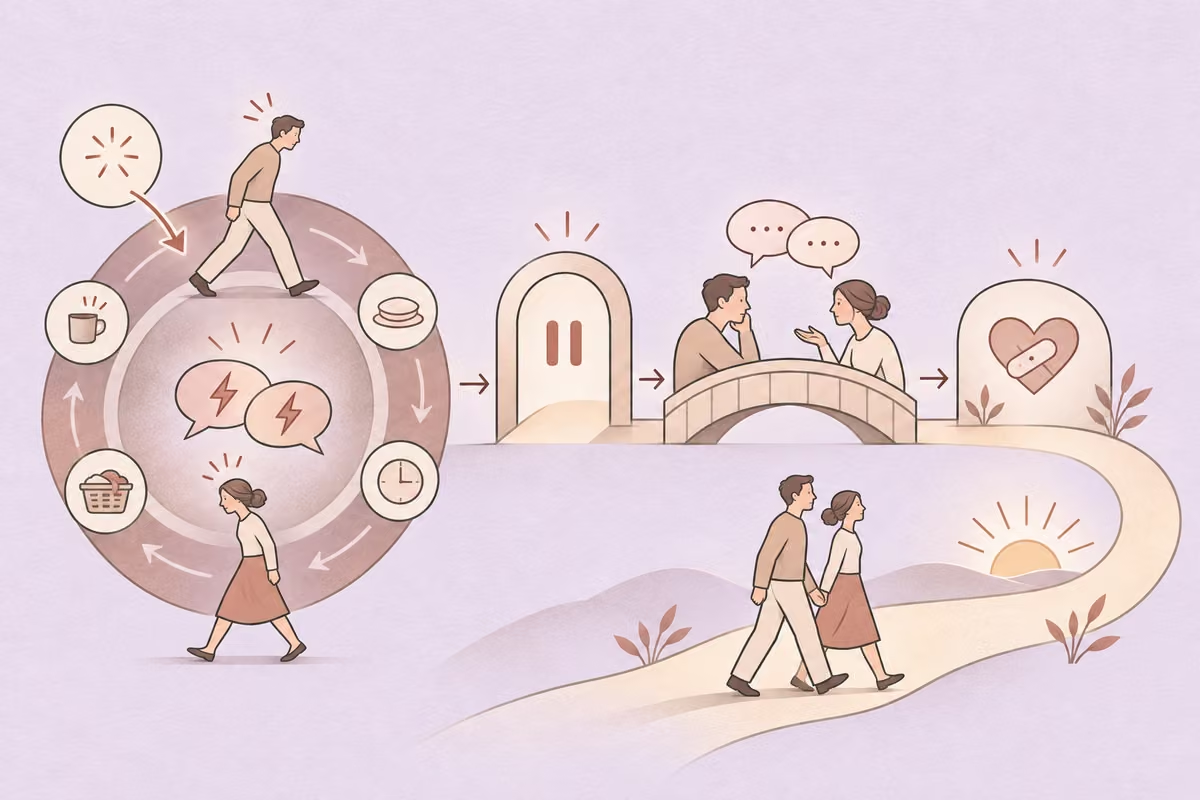
One of the most common cycles is described by emotionally focused therapy. One partner responds to distance by intensifying attempts at contact: insisting, criticising, demanding a conversation. The other responds to pressure by shutting down: going silent, leaving the room, turning to their phone. The more one pushes, the more the other withdraws, and vice versa. Both are protecting themselves, yet each sees the other's behaviour as an attack.
Four destructive patterns
Relationship researcher John Gottman spent decades observing couples in the lab and identified four conflict behaviours that are especially strongly linked to relationship breakdown:
- Criticism — attacking the person rather than discussing the behaviour: "you always forget everything" instead of "I was upset that you forgot".
- Contempt — sarcasm, mockery, eye-rolling, a sense of superiority. Gottman considers it the strongest predictor of separation.
- Defensiveness — excuses and counter-accusations instead of hearing the complaint.
- Stonewalling — emotional shutdown, silence, ignoring.
The good news is that each pattern has an antidote, and it can be learned.
Perpetual problems
According to Gottman, most conflicts in a couple stem from lasting differences in temperament, values and habits rather than specific problems that can be solved once and for all. Happy couples do not eliminate these differences. They learn to talk about them without hostility, with humour and respect.
What happens in the body during a fight
When a conflict becomes too intense, the stress response kicks in: heart rate rises, attention narrows, and the capacity to listen and think flexibly drops. Gottman calls this emotional flooding. In that state a productive conversation is almost impossible — the person hears a threat, not words.
Hence a practical rule: if you feel flooded, agree on a break of at least 20–30 minutes and return to the conversation once your body has calmed down. The key word is return — a break must not turn into avoiding the conversation.
How to break a repeating pattern
1. Name the cycle instead of blaming your partner
The biggest shift happens when a couple starts to see a common enemy — the cycle, not each other: "I think we're in our loop again: I start pushing and you shut down."
2. Start gently
How a conversation begins largely determines how it ends. Talk about yourself and the specific situation: "I was upset when…", "it matters to me that…", "I'd like…". Avoid "always" and "never".
3. Talk about what lies beneath the trigger
Ask yourself: what does this situation mean to me? What am I afraid of, what do I need? "I miss feeling that we're a team" opens a conversation; "you didn't do the dishes again" closes it.
4. Listen to understand, not to reply
Paraphrase what you heard and check whether you understood correctly. This slows the conversation down and lowers the temperature.
5. Notice repair attempts
A joke, a touch, "let's start over" — these are attempts to ease tension. In stable couples they are more often noticed and accepted.
6. Invest in closeness outside conflict
The more warmth, appreciation and good time together a couple has, the easier fights are to weather. Conflict is only one part of a relationship, and its outcome depends heavily on what happens between fights.
When to see a psychologist
- The same fights have been repeating for months and you cannot break the cycle on your own.
- Contempt, insults or long silences appear in your conflicts.
- After fights you are left feeling lonely and distant.
- One or both partners are thinking about separating.
- The conflicts are linked to a major event: infidelity, the birth of a child, a move, illness, job loss.
You can come as a couple or on your own: changing your own role in the cycle often changes the dynamics of the whole couple.
Important: if there is physical violence, threats or severe control in the relationship, safety comes first. Joint couples work is not recommended in that situation — start with individual help and specialised support services.
How I work with relationships
I help adults sort out conflicts with the people close to them: see the repeating script, understand which feelings and needs lie behind it for each person, and learn to talk about what matters in a way that gets heard. I take into account not only emotions but the real context of life: workload, money, children, work, past experience. Sessions are online.
Frequently asked questions
Is it normal for couples to fight?
Yes. Every couple has disagreements. What matters for the relationship is not how often conflicts happen but how they go: whether respect is maintained, whether partners hear each other and reconnect afterwards.
Why do we keep fighting about the same thing?
Because most conflicts stem from lasting differences in temperament, habits and values. A recurring fight signals that behind the trigger is an important need that has not yet been heard.
Can a relationship change if my partner won't see a psychologist?
Yes, in many cases. When one partner changes their role in the cycle — starting gently, taking a break instead of escalating, talking about needs — the couple's dynamics often shift as a result.
How do we stop fighting?
The goal is not to stop fighting altogether but to stop fights from damaging the relationship. A gentle start, breaks when flooded, talking about the needs behind the trigger and attention to repair attempts all help.
Sources
- Gottman J. M., Silver N. The Seven Principles for Making Marriage Work, 2nd ed., 2015.
- Gottman J. M. What Predicts Divorce? The Relationship Between Marital Processes and Marital Outcomes, 1994.
- Johnson S. M. Hold Me Tight: Seven Conversations for a Lifetime of Love, 2008.
This article is for educational purposes only and does not constitute psychological counselling or assessment. Every situation is different, so for help with your own circumstances, please consult a qualified professional.