Bipolar Depression: How It Differs From Ordinary Depression
How bipolar depression differs from unipolar depression, how to recognise mania and hypomania, and why getting the diagnosis right changes treatment.
Contents
- Unipolar and bipolar depression
- What mania and hypomania are
- Mania
- Hypomania
- Types of bipolar disorder
- Why bipolar depression often goes unrecognised
- Signs that may point to bipolar disorder
- How bipolar depression resembles ordinary depression
- Why the right diagnosis matters
- How it is treated
- A mood diary
- How I can help
- Frequently asked questions
- What is bipolar depression?
- How is bipolar depression different from ordinary depression?
- What is manic depression?
- How do I know if I have bipolar disorder?
- Can bipolar depression be treated with antidepressants?
- When should I seek help urgently?
- About the author
- Sources
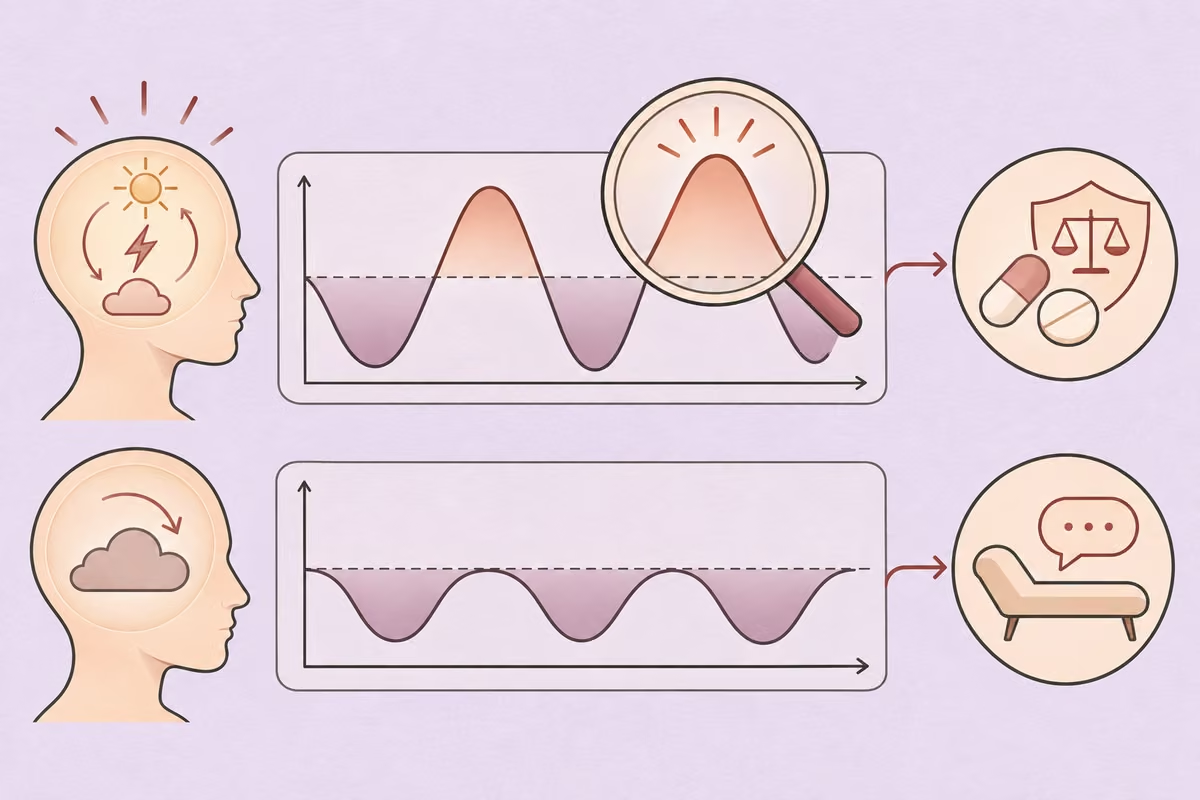
In short: bipolar depression is the depressive phase of bipolar disorder, a condition in which periods of depression alternate with periods of mania or hypomania — an unusually elevated mood, a surge of energy and a reduced need for sleep. It used to be called manic depression. On the surface, bipolar depression looks much like ordinary depression, but it is treated differently. Many people with bipolar disorder spend far more time depressed than manic, so they are treated for ordinary depression for years. That carries a real risk: some treatments for ordinary depression, given without protective medication, can trigger mania. This is why it matters so much to tell your doctor about any past episodes of unusually good mood or bursts of energy.
Unipolar and bipolar depression
- Unipolar depression is ordinary depression, with no episodes of mania or hypomania. Clinically it is called major depressive disorder.
- Bipolar depression is depression in a person who has had at least one episode of mania or hypomania.
"Pole" here means an extreme state of mood. Unipolar depression has only one pole, the depressive one; bipolar depression has two.
What mania and hypomania are
Mania
The state lasts at least a week or is severe enough to require hospital care:
- an unusually elevated, expansive or irritable mood;
- increased energy and activity;
- a reduced need for sleep — the person sleeps three or four hours and feels rested;
- rapid speech, racing thoughts, jumping from topic to topic;
- inflated self-esteem, a sense of being all-powerful;
- risky behaviour: spending sprees, gambling, impulsive decisions, risky sexual encounters;
- sometimes delusions and hallucinations.
Mania seriously disrupts life, work and relationships.
Hypomania
A milder form. It lasts at least four days, does not cause serious disruption and does not require hospital care. The person feels very energetic, productive and sociable and needs less sleep. Both the person and those around them often see it as "a good spell" rather than a symptom — and so it never gets mentioned to a doctor.
Types of bipolar disorder
- Bipolar I disorder: there are episodes of mania, and usually depression as well.
- Bipolar II disorder: episodes of hypomania and depression, but no full mania. Depressions in this type are often severe and long.
- Cyclothymia: long-term mood swings between mild depressive and hypomanic states that never reach the level of full episodes.
According to Kathleen Merikangas and colleagues (2011), bipolar spectrum disorders of all types affect roughly 2–2.5% of people over their lifetime.
Why bipolar depression often goes unrecognised
- People with bipolar disorder spend much more time depressed than manic. In studies by Lewis Judd and colleagues, depressive symptoms took up about a third of the time in people with bipolar I disorder and about half the time in people with bipolar II.
- People rarely see hypomania as a problem.
- People come to a doctor when they are depressed, not when they are manic.
As a result, it often takes years between the first symptoms and the correct diagnosis.
Signs that may point to bipolar disorder
A doctor may suspect bipolar disorder if:
- depression first began in adolescence or early adulthood;
- close relatives have bipolar disorder;
- there have been many depressive episodes that start and end abruptly;
- there are atypical features: excessive sleepiness, increased appetite, a heavy feeling in the body;
- there are psychotic symptoms;
- depression began after childbirth;
- agitation, insomnia or racing thoughts appeared while taking antidepressants;
- during depression there are some signs of mania — rapid speech, racing thoughts, increased energy. These are called mixed features.
How bipolar depression resembles ordinary depression
The symptoms are the same: low mood, loss of interest, disturbed sleep and appetite, fatigue, guilt, difficulty concentrating, thoughts of death. The forms and degrees of depression are covered in detail in "Types and Severity of Depression".
Why the right diagnosis matters
- Treatment of bipolar depression is usually built around mood-stabilising medication. Only a psychiatrist can choose it.
- In people with bipolar disorder, antidepressants given without protective medication can trigger mania, a mixed state, or faster switching between phases.
- Bipolar disorder carries a high risk of suicide, especially during depressive and mixed phases.
How it is treated
- Medication, chosen by a psychiatrist. Usually mood-stabilising drugs and some others. As a rule, they need to be taken long-term.
- Psychoeducation: understanding the illness, the early signs of each phase, and the role of sleep and stress.
- Psychotherapy. Interpersonal and social rhythm therapy helps stabilise daily routine and sleep; cognitive behavioural therapy helps manage depression and spot early warning signs; family therapy reduces tension at home.
- A regular sleep schedule. Sleep deprivation can trigger mania.
- Avoiding alcohol and other psychoactive substances.
A mood diary
Keeping a mood diary is a simple and useful tool. Each day, note:
- your mood on a scale, for example from minus five to plus five;
- how many hours you slept;
- your energy level;
- whether you took your medication;
- important events.
This helps both you and your doctor notice early signs that a phase is changing.
How I can help
In online support for adults, I help people with bipolar disorder deal with the aftermath of depressive phases, build a steady routine, recognise early warning signs and work on their relationships. Psychotherapy for bipolar disorder always runs in parallel with care from a psychiatrist.
Frequently asked questions
What is bipolar depression?
It is the depressive phase of bipolar disorder — an illness in which periods of depression alternate with periods of mania or hypomania. It looks like ordinary depression but is treated differently.
How is bipolar depression different from ordinary depression?
The symptoms are similar, but a person with bipolar depression has had episodes of mania or hypomania. Bipolar depression more often starts at a young age, more often comes with sleepiness and increased appetite, and needs different treatment.
What is manic depression?
It is the old name for bipolar disorder. Today the term "bipolar disorder" (or bipolar affective disorder) is used.
How do I know if I have bipolar disorder?
If, apart from depressions, you have had periods of unusually high mood, surges of energy, a reduced need for sleep, rapid speech and impulsive actions, be sure to tell a psychiatrist. Only a doctor can make the diagnosis.
Can bipolar depression be treated with antidepressants?
Only a psychiatrist can decide. In people with bipolar disorder, antidepressants without mood-stabilising medication can trigger mania, so treatment is chosen differently than for ordinary depression.
When should I seek help urgently?
If you have thoughts of suicide or of harming yourself, do not wait for a scheduled appointment: contact your local emergency services or a 24/7 crisis line.
About the author
More than 15 years in psychology and working with people. Degree in psychology from HSE University, four years of training at the Moscow Gestalt Institute, specialisation in long-term therapy of personality disorders and short-term trauma therapy. I provide online support for adults.
Sources
- Grande I. et al. Bipolar disorder. The Lancet, 2016.
- Merikangas K. R. et al. Prevalence and correlates of bipolar spectrum disorder in the World Mental Health Survey Initiative. Archives of General Psychiatry, 2011.
- Judd L. L. et al. The long-term natural history of the weekly symptomatic status of bipolar I disorder. Archives of General Psychiatry, 2002.
- Judd L. L. et al. A prospective investigation of the natural history of the long-term weekly symptomatic status of bipolar II disorder. Archives of General Psychiatry, 2003.
- Yatham L. N. et al. Canadian Network for Mood and Anxiety Treatments (CANMAT) and International Society for Bipolar Disorders (ISBD) 2018 guidelines for the management of patients with bipolar disorder. Bipolar Disorders, 2018.
- Frank E. et al. Two-year outcomes for interpersonal and social rhythm therapy in individuals with bipolar I disorder. Archives of General Psychiatry, 2005.
This article is for educational purposes only and does not constitute medical advice, a diagnosis or a treatment recommendation. The symptoms and methods described are meant to help you understand the topic; only a doctor or qualified professional can assess your condition, make a diagnosis and recommend treatment after an individual consultation.