Types of Depression: Mild, Moderate, Severe, Chronic, Atypical
Mild, moderate and severe depression, plus its main forms — clinical, recurrent, chronic, atypical, melancholic and treatment-resistant — and how an episode unfolds.
Contents
- Levels of severity
- Mild depression
- Moderate depression
- Severe depression
- Clinical depression
- Forms by course
- Single episode
- Recurrent depression
- Chronic depression: dysthymia
- Double depression
- Treatment-resistant depression
- Forms by symptom pattern
- Melancholic depression
- Atypical depression
- Anxious depression
- Depression with mixed features
- Variants described in Russian psychiatry
- Special forms
- Stages of a depressive episode
- How I can help
- Frequently asked questions
- What are the levels of depression?
- What is clinical depression?
- What is chronic depression?
- How is atypical depression different from ordinary depression?
- What is recurrent depression?
- When should I seek help urgently?
- About the author
- Sources
In short: depression is classified by severity and by form. By severity it can be mild, moderate or severe, depending on how many symptoms there are, how strong they are and how much they interfere with life. By course, there is a single episode, recurrent depression with repeated episodes, and chronic depression that lasts two years or longer. By the pattern of symptoms there are, for example, melancholic and atypical depression. Some forms — bipolar, psychotic, postpartum and seasonal depression — deserve separate discussion. Form and severity matter because treatment depends on them.
Levels of severity
Mild depression
- There are few symptoms, just above the minimum needed for a diagnosis.
- The person has noticeable difficulties but generally keeps working, studying and handling responsibilities, though with much more effort.
- Psychotherapy, behavioural activation and physical activity are often enough.
Moderate depression
- There are more symptoms, and they are stronger.
- Work, housework and social contact become considerably harder.
- Psychotherapy is usually recommended, and medication prescribed by a doctor if needed.
Severe depression
- Many symptoms are intense: deep low mood, loss of interest in everything, strong guilt and worthlessness, noticeable slowing down or agitation, severe sleep and appetite problems.
- Even basic things are hard — getting out of bed, eating, washing.
- Thoughts of death and suicide are common.
- Sometimes psychotic symptoms appear, such as delusions of guilt or ruin.
- A psychiatrist's care is needed, usually a combination of medication and psychotherapy, sometimes inpatient treatment.
In ICD-10 these levels are coded F32.0 (mild episode), F32.1 (moderate), F32.2 (severe without psychotic symptoms) and F32.3 (severe with psychotic symptoms).
Clinical depression
"Clinical depression" is an everyday term for depression that meets the medical criteria for a diagnosis, as opposed to a temporary low mood. In the American classification it corresponds to major depressive disorder; in the ICD, to a depressive episode. "Major depression" is the same concept, not a particularly severe form.
Forms by course
Single episode
Depression happened once and resolved with treatment or over time.
Recurrent depression
Repeated depressive episodes with periods of normal well-being in between. After one episode the risk of another is about 50%; after two it is higher, after three higher still. This is why maintenance treatment and prevention are especially important in recurrent depression.
Chronic depression: dysthymia
- Low mood on most days for two years or longer.
- Symptoms are usually milder than in major depression but long-lasting.
- A person may believe for years that this is simply their personality: "I've always been like this."
- In DSM-5 this is called persistent depressive disorder.
Double depression
When an episode of major depression develops on top of chronic dysthymia. It is one of the reasons people say they have had "depression for years".
Treatment-resistant depression
Depression is called treatment-resistant if it does not respond to two or more courses of different antidepressants at an adequate dose and for an adequate length of time. This applies to roughly a third of people. Resistance is not a dead end: there are other treatment options, and a psychiatrist chooses them.
Forms by symptom pattern
Melancholic depression
- An almost complete loss of the ability to feel pleasure — even good news does not lift the mood.
- A particular quality of low mood, a heavy anguish unlike ordinary sadness.
- Feeling worse in the morning.
- Waking up very early.
- Noticeable slowing down or agitation.
- Loss of appetite and weight loss.
- Excessive guilt.
This is close to what used to be called endogenous depression.
Atypical depression
Despite the name, it is common.
- Mood can brighten in response to good events.
- Increased appetite and weight gain.
- Excessive sleepiness.
- A heavy feeling in the arms and legs, known as "leaden paralysis".
- High sensitivity to rejection in relationships.
Anxious depression
Depression with marked anxiety, tension and worry. How anxiety works on its own is explained in "Anxiety for No Reason: What Happens in the Brain".
Depression with mixed features
When some signs of mania appear during depression: rapid speech, racing thoughts, increased energy. This is important to recognise because it may point to bipolar disorder. More in "Bipolar Depression".
Variants described in Russian psychiatry
Russian and Eastern European psychiatric literature often describes depression by its leading experience:
- melancholic anguish — a heavy, "stone on the heart" sadness;
- anxious — dominated by worry and fears;
- apathetic, or adynamic — a lack of drive and energy;
- asthenic — marked exhaustion and weakness.
Special forms
Several forms have their own features and are worth knowing about:
- bipolar depression;
- psychotic depression;
- postpartum depression;
- seasonal depression;
- hidden, "smiling" and high-functioning depression — see "Depression or Something Else?".
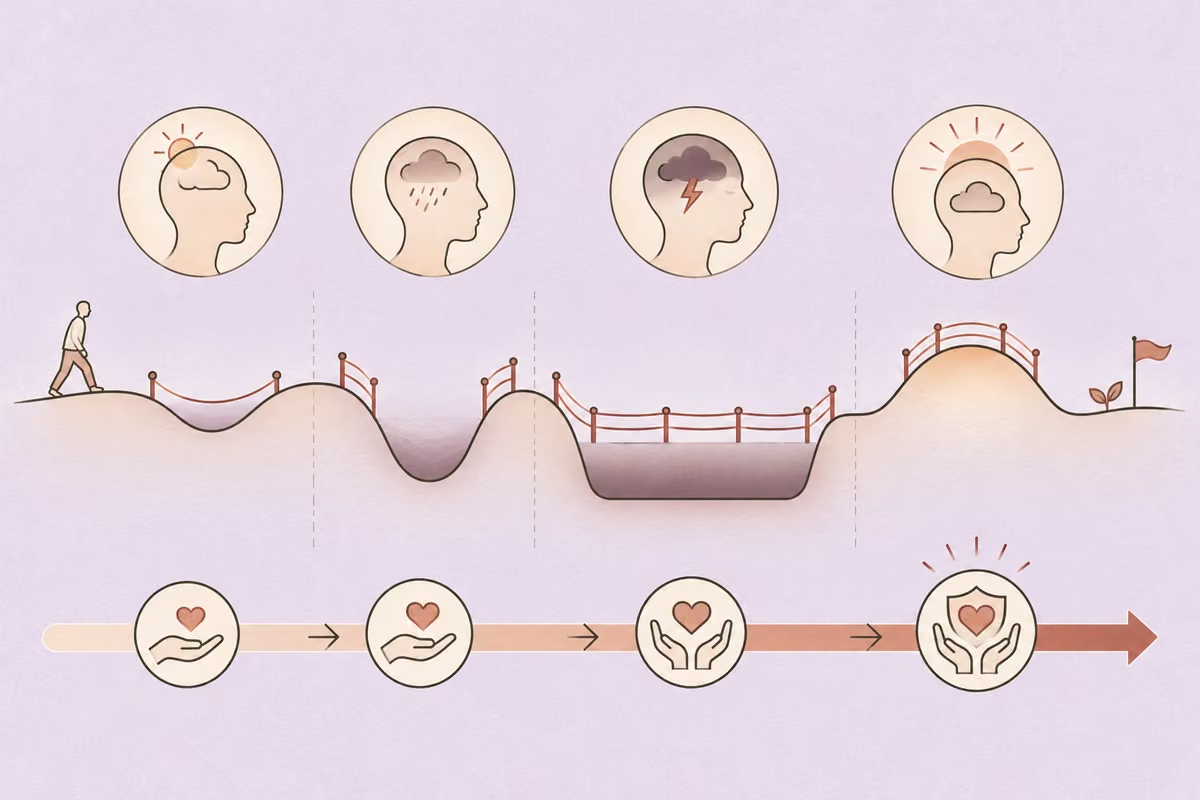
Stages of a depressive episode
Depression has no official "stages", but doctors describe the course of an episode like this:
- Onset: a gradual, sometimes barely noticeable build-up of symptoms — fatigue, poor sleep, irritability, loss of interest.
- Acute phase: symptoms are fully developed and interfere with life.
- Response to treatment: symptoms decrease by at least half.
- Remission: symptoms almost completely disappear.
- Recovery: remission holds for several months.
If symptoms return during remission, it is called a relapse; if they return after recovery, it is a new episode.
How I can help
In online support for adults, I work with people with mild and moderate depression, and with severe depression I work alongside a psychiatrist. Understanding the form of depression helps choose the approach: in chronic depression, for example, it is important to work with deep-seated beliefs and relationships, while in recurrent depression the focus is on prevention.
Frequently asked questions
What are the levels of depression?
Depression can be mild, moderate or severe. The level depends on how many symptoms there are, how strong they are, and how much they get in the way of work, relationships and looking after yourself.
What is clinical depression?
It is an everyday name for depression that meets the medical criteria for a diagnosis: at least five symptoms, including low mood or loss of interest, lasting at least two weeks.
What is chronic depression?
Chronic depression, or dysthymia, is low mood on most days for two years or longer. The symptoms are usually milder than in major depression but persist for years.
How is atypical depression different from ordinary depression?
In atypical depression, mood can lift with good events, appetite and sleepiness are increased, the body feels heavy, and there is high sensitivity to rejection. Classic depression more often comes with loss of appetite and insomnia.
What is recurrent depression?
It means repeated depressive episodes with normal well-being in between. The risk of a new episode grows after each one, so maintenance treatment and prevention matter.
When should I seek help urgently?
If you have thoughts of suicide or of harming yourself, do not wait for a scheduled appointment: contact your local emergency services or a 24/7 crisis line.
About the author
More than 15 years in psychology and working with people. Degree in psychology from HSE University, four years of training at the Moscow Gestalt Institute, specialisation in long-term therapy of personality disorders and short-term trauma therapy. I provide online support for adults.
Sources
- American Psychiatric Association. Diagnostic and Statistical Manual of Mental Disorders, Fifth Edition, Text Revision (DSM-5-TR). 2022.
- World Health Organization. International Classification of Diseases, 11th Revision (ICD-11). 2019.
- Kupfer D. J. Long-term treatment of depression. Journal of Clinical Psychiatry, 1991.
- Rush A. J. et al. Acute and longer-term outcomes in depressed outpatients requiring one or several treatment steps: a STAR*D report. American Journal of Psychiatry, 2006.
- Keller M. B., Shapiro R. W. "Double depression": superimposition of acute depressive episodes on chronic depressive disorders. American Journal of Psychiatry, 1982.
- National Institute for Health and Care Excellence. Depression in adults: treatment and management (NG222). 2022.
This article is for educational purposes only and does not constitute medical advice, a diagnosis or a treatment recommendation. The symptoms and methods described are meant to help you understand the topic; only a doctor or qualified professional can assess your condition, make a diagnosis and recommend treatment after an individual consultation.