How to Get Out of Depression on Your Own: What Actually Helps
What you can do yourself to climb out of depression: behavioural activation, small steps, exercise, sleep, food, negative thoughts and rumination, connection — and when self-help is not enough.
Contents
- Why "pull yourself together" does not work
- Step 1. Behavioural activation
- Step 2. Very small steps
- Step 3. Movement
- Step 4. Sleep
- Step 5. Food
- Step 6. Cutting out alcohol
- Step 7. Working with thoughts
- Step 8. Rumination
- Step 9. Connection
- Step 10. Kindness towards yourself
- What to avoid
- When self-help is not enough
- How I can help
- Frequently asked questions
- Can you get out of depression on your own?
- What should I do if I don't feel like doing anything?
- Does exercise help with depression?
- How can I cope with depression without medication?
- When should I see a professional?
- About the author
- Sources
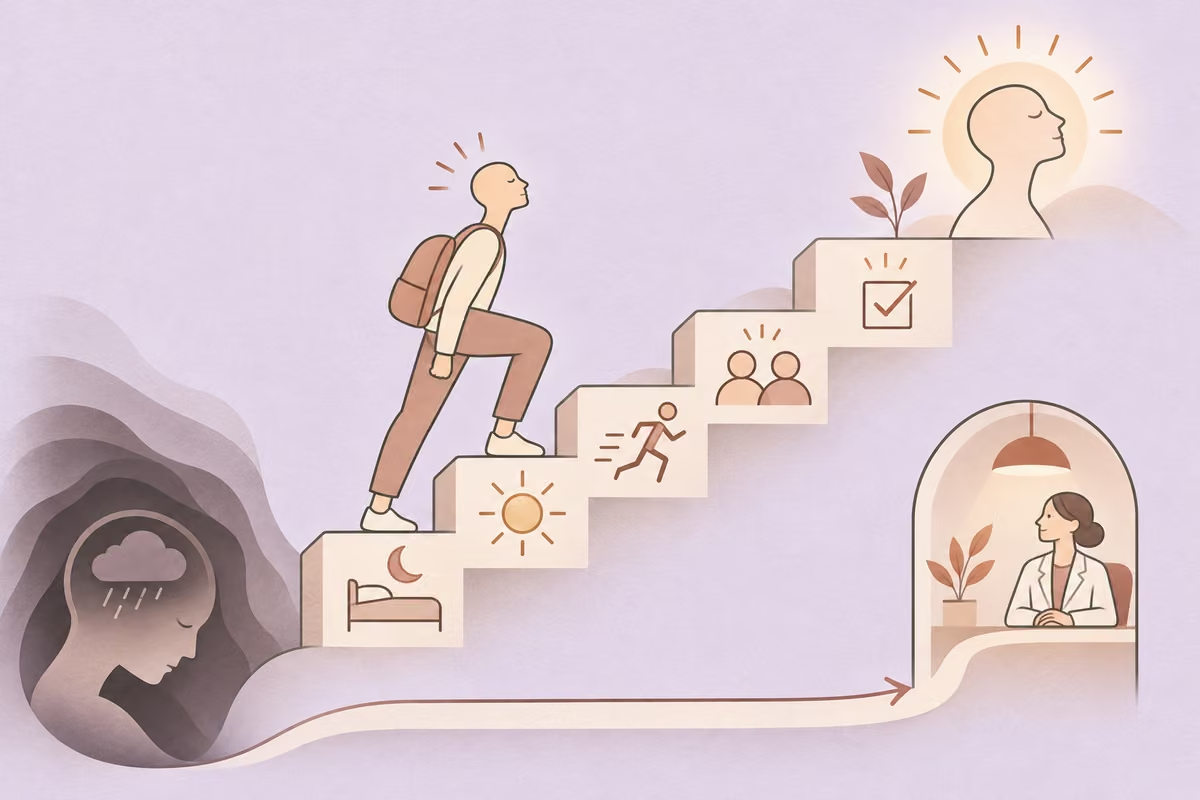
In short: in mild depression, self-help can noticeably improve how you feel, and in moderate and severe depression it can strengthen the effect of treatment. The key principle is to act according to a plan, not according to your mood: in depression, motivation comes after action, not before it. The best-studied approaches are behavioural activation — gradually bringing back enjoyable and meaningful activities — regular physical activity, a stable sleep schedule, working with negative thoughts and rumination, and staying connected with people. Start with very small steps. If things are not getting better after a few weeks, if you feel worse, or if thoughts of death appear, self-help is not enough and it is time to see a professional.
Why "pull yourself together" does not work
Depression drains energy, motivation and the ability to feel pleasure. That is why advice like "get a grip" or "think positive" only produces guilt. What works is not willpower but small, concrete actions that gradually shift your state.
Step 1. Behavioural activation
This is one of the most effective methods for depression. It rests on a simple idea: in depression, people stop doing things that bring pleasure and a sense of meaning, which makes them feel even worse, and the circle closes. Behavioural activation breaks that circle.
How to use it:
- For a few days, write down what you do and how you feel, on a scale from 0 to 10.
- Make a list of activities that used to bring you pleasure and of things that matter to you: meeting people, walks, hobbies, tidying up, caring for someone.
- Each day, schedule one or two small activities from the list at a specific time.
- Do them even if you do not feel like it. Note how your mood changed afterwards.
- Gradually increase the number and difficulty of activities.
Step 2. Very small steps
When you have almost no energy, break any task into the smallest possible pieces:
- not "clean the flat", but "clear one cup off the table";
- not "go to the gym", but "go outside for five minutes";
- not "answer all my messages", but "reply to one person".
Give yourself credit for every step. In depression, even a small action is an achievement.
Step 3. Movement
Physical activity is one of the best-proven tools against depression. In a 2024 meta-analysis by Michael Noetel and colleagues, walking, running, yoga, strength training and mixed exercise all noticeably reduced symptoms.
- Start with 10–15 minutes of walking a day.
- Outdoors and in daylight is better.
- Gradually increase the time and intensity.
- Choose something you can manage and do not dread.
Step 4. Sleep
- Go to bed and get up at the same time every day, including weekends.
- Avoid lying in bed for hours during the day: it increases weakness and disrupts night-time sleep.
- Get out into daylight in the morning.
- Limit caffeine after lunch and screens before bed.
- If you cannot fall asleep for a long time, get up and do something calm, and go back to bed when you feel sleepy.
Step 5. Food
- Eat regularly, even without an appetite: small portions are fine.
- A Mediterranean-style diet — vegetables, fruit, whole grains, fish, legumes, nuts, olive oil — is associated with a lower risk of depression. In the SMILES trial by Felice Jacka and colleagues (2017), switching to this kind of diet reduced symptoms of depression.
- Cut down on sweets and ultra-processed foods.
- Do not take supplements or "natural remedies for depression" without talking to a doctor: some of them interact with medication.
Step 6. Cutting out alcohol
Alcohol dulls painful feelings for a while, but it deepens depression, disrupts sleep and raises the risk of suicide. More in "Depression, Anxiety and Addiction".
Step 7. Working with thoughts
Depression distorts perception: everything seems hopeless and you seem worthless. It helps to:
- Notice automatic thoughts: "I'll ruin everything", "Nobody cares about me".
- Write them down.
- Ask yourself: what is the evidence for and against? What would I say to a friend in this situation? Is there another explanation?
- Put together a more balanced thought.
This is the basis of cognitive behavioural therapy. For self-guided work, books based on CBT are useful — for example, David Burns's "Feeling Good: The New Mood Therapy".
Step 8. Rumination
Rumination is endlessly going over dark thoughts: "Why do I feel so bad? What's wrong with me?" It prolongs depression.
- Notice the moment you start chewing over the same thing again.
- Switch to action: a walk, something hands-on, a conversation.
- Set aside 15 minutes a day for worrying thoughts, and postpone them "until later" the rest of the time.
- Mindfulness practices help you observe thoughts without getting pulled into them.
Step 9. Connection
Depression pushes you towards isolation, and isolation makes it worse.
- Stay in touch with at least one person you trust.
- Tell people close to you what is going on and what kind of help you need.
- You do not have to talk about depression — simply spending time with someone is enough.
- Support groups help you feel that you are not alone.
Step 10. Kindness towards yourself
- Talk to yourself the way you would talk to someone close to you who is struggling.
- Do not expect your old productivity from yourself.
- Remember that depression is an illness, not your fault.
What to avoid
- Making major decisions — quitting a job, divorce, moving — in the middle of depression, if they can wait.
- Treating yourself with alcohol, sedatives or medication not prescribed by a doctor.
- Comparing yourself with others on social media.
- Isolating yourself.
When self-help is not enough
- After three or four weeks of self-help, things are not getting better.
- You are getting worse.
- Basic everyday tasks are hard to manage.
- Thoughts of death or self-harm have appeared — in this case seek help right away; in an acute crisis, contact your local emergency services or a 24/7 crisis line.
If you are unsure what kind of help to look for, "How to Choose a Psychologist Online" explains what to pay attention to. What depression is and how it is treated is covered in "What Is Depression?".
How I can help
In online support for adults, we put together a behavioural activation plan, work with self-criticism and rumination, and look for sources of support. Many people find it easier to take the first steps when someone is there to help them stay on course.
Frequently asked questions
Can you get out of depression on your own?
In mild depression, often yes: behavioural activation, physical activity, a sleep routine and working with thoughts help noticeably. In moderate and severe depression, self-help strengthens treatment but does not replace it.
What should I do if I don't feel like doing anything?
Do not wait for motivation; start with very small actions according to a plan. In depression, motivation often comes after action. Behavioural activation is built on exactly this principle.
Does exercise help with depression?
Yes. Research shows that walking, running, yoga and strength training noticeably reduce symptoms of depression. Starting with 10–15 minutes of walking a day is a good beginning.
How can I cope with depression without medication?
In mild depression, psychotherapy, behavioural activation, physical activity, a sleep routine, diet and connection with others help. In moderate and severe depression, the decision about medication is made together with a doctor.
When should I see a professional?
If after three or four weeks of self-help things are not improving, you are getting worse, basic tasks are hard to manage, or thoughts of death have appeared. In the last case, seek help immediately.
About the author
More than 15 years in psychology and working with people. Degree in psychology from HSE University, four years of training at the Moscow Gestalt Institute, specialisation in long-term therapy of personality disorders and short-term trauma therapy. I provide online support for adults.
Sources
- Ekers D. et al. Behavioural activation for depression; an update of meta-analysis of effectiveness and sub group analysis. PLoS One, 2014.
- Noetel M. et al. Effect of exercise for depression: systematic review and network meta-analysis of randomised controlled trials. BMJ, 2024.
- Jacka F. N. et al. A randomised controlled trial of dietary improvement for adults with major depression (the "SMILES" trial). BMC Medicine, 2017.
- Nolen-Hoeksema S., Wisco B. E., Lyubomirsky S. Rethinking rumination. Perspectives on Psychological Science, 2008.
- Cuijpers P. et al. Self-guided psychological treatment for depressive symptoms: a meta-analysis. PLoS One, 2011.
- Burns D. D. Feeling Good: The New Mood Therapy. 1980.
- National Institute for Health and Care Excellence. Depression in adults: treatment and management (NG222). 2022.
This article is for educational purposes only and does not constitute medical advice, a diagnosis or a treatment recommendation. The symptoms and methods described are meant to help you understand the topic; only a doctor or qualified professional can assess your condition, make a diagnosis and recommend treatment after an individual consultation.