What Is Depression? A Plain-Language Explanation
What depression is and how it differs from a bad mood: how doctors define it, why it is an illness and not a weakness, how common it is, how it is diagnosed and treated.
Contents
- How depression differs from a bad mood
- How doctors define depression
- Why depression is an illness, not a weakness
- How common depression is
- What kinds of depression there are
- How it is diagnosed
- How depression is treated
- When urgent help is needed
- Articles about depression in English
- How I can help
- Frequently asked questions
- What is depression in simple terms?
- Is depression an illness?
- How is depression different from sadness?
- What is the ICD code for depression?
- Can depression be cured?
- About the author
- Sources
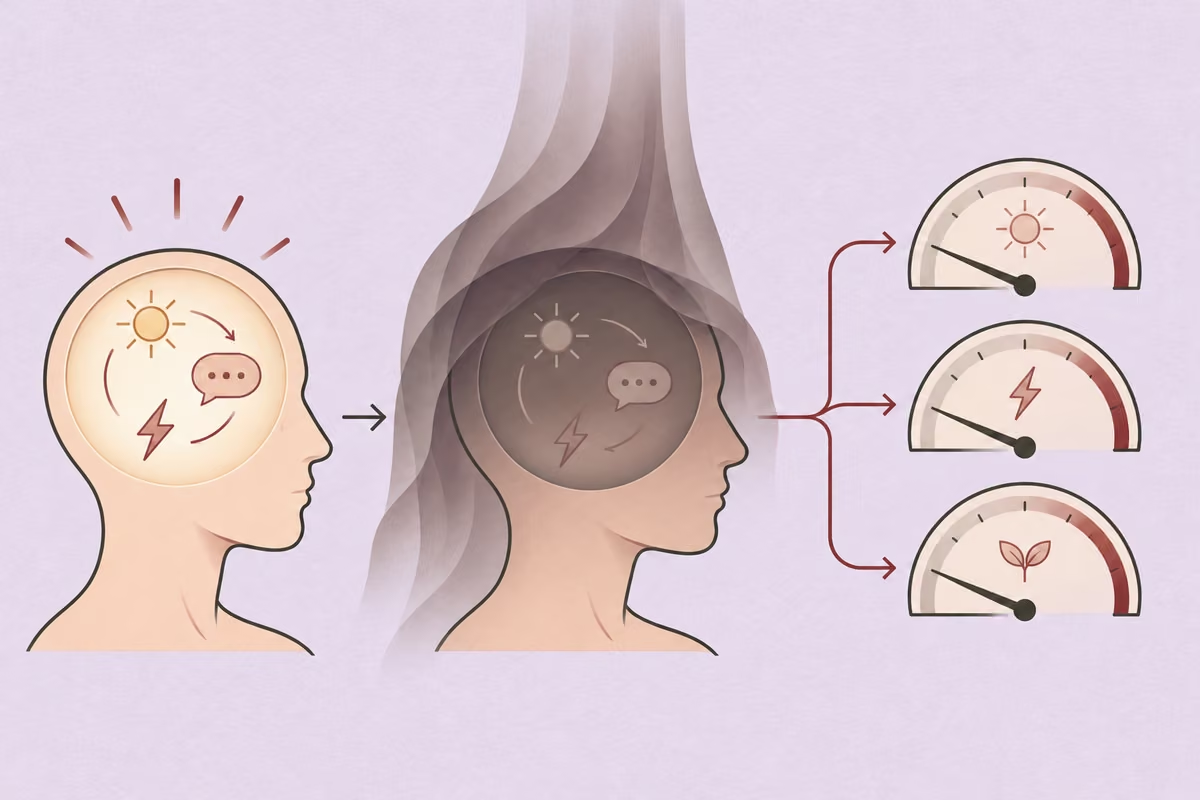
In short: depression is a mental disorder in which low mood or a loss of interest and pleasure lasts for most of the day, nearly every day, for at least two weeks and gets in the way of life. It is not just sadness, and it is not a weakness of character. Depression changes sleep, appetite, energy, thinking, self-esteem and the ability to act. The World Health Organization estimates that about 280 million people worldwide live with it. Depression responds well to treatment: psychotherapy, medication prescribed by a doctor and lifestyle changes help most people. The diagnosis is made by a doctor, usually a psychiatrist.
How depression differs from a bad mood
Everyone has times of sadness, disappointment and low energy. These are normal reactions to losses, setbacks and tiredness. They usually pass within hours or days, and even in a bad patch a person can still enjoy good things.
Depression is different in several ways:
- duration — it lasts two weeks or longer, nearly every day;
- depth — the low mood does not lift with good news;
- breadth — not only mood changes, but also sleep, appetite, energy, concentration and how you see yourself;
- consequences — it becomes hard to work, study, socialise and look after yourself.
How to tell depression from apathy, laziness, burnout and ordinary sadness is covered in "Depression or Something Else?".
How doctors define depression
Doctors rely on international classifications. The International Classification of Diseases, 11th Revision (ICD-11), came into effect in 2022, but many countries are still transitioning to it and medical records often still use ICD-10. In ICD-10, a depressive episode is coded F32 and recurrent depressive disorder F33. The American classification DSM-5 describes major depressive disorder.
Both systems agree on the essentials. A diagnosis requires at least one of two core signs:
- low mood for most of the day, nearly every day;
- a marked loss of interest or pleasure in activities that used to be enjoyable.
Other symptoms are added to these: disturbed sleep, changes in appetite and weight, fatigue and loss of energy, difficulty concentrating, feelings of guilt or worthlessness, slowing down or restlessness, thoughts of death. Under DSM-5 there must be at least five symptoms in total, lasting at least two weeks.
Why depression is an illness, not a weakness
Depression is linked to changes in how the brain and body work: in the systems that regulate stress, in signalling between nerve cells, and in brain networks responsible for emotion and motivation. Genetics, chronic stress, traumatic experiences, physical illness and living conditions all play a part in its development. None of these depend on "willpower".
That is why advice like "pull yourself together" or "just think positive" does not work: a person with depression cannot simply decide to stop feeling it, just as someone with a high fever cannot decide to bring their temperature down.
How common depression is
- According to the WHO, about 5% of adults worldwide live with depression.
- Women are affected roughly one and a half to two times as often as men — see "Depression in Women, Men and Older Adults".
- Depression can start at any age, including in children and teenagers, but most often first appears in adolescence and young adulthood.
- The WHO names depression as one of the leading causes of disability worldwide.
What kinds of depression there are
Depression varies by severity — mild, moderate, severe — and by course: a single episode, repeated episodes, or a chronic form. There are also special forms: postpartum, seasonal, depression within bipolar disorder, and depression with psychotic symptoms. More in "Types of Depression".
How it is diagnosed
The diagnosis is made by a doctor, based on a conversation. They ask about symptoms, how long they have lasted and how they affect life, about past episodes, illnesses, medication and substance use, and about family history.
- There is no blood test that confirms depression. But a doctor may order tests to rule out other causes, such as thyroid problems or anaemia — see "Depression and Physical Illness".
- Questionnaires and screening tests help gauge how strong the symptoms are, but they do not replace a doctor.
How depression is treated
- Psychotherapy — above all cognitive behavioural therapy, interpersonal therapy and behavioural activation. For mild depression it is often enough on its own.
- Medication — antidepressants are prescribed only by a doctor, usually for moderate and severe depression. Choosing the medicine and the dose, and stopping it, should happen only under medical supervision.
- A combination of psychotherapy and medication — for moderate and severe depression this is usually more effective than either alone.
- Lifestyle — physical activity, a regular sleep schedule and support from loved ones strengthen the effect of treatment.
What you can do yourself is described in "How to Get Out of Depression on Your Own".
When urgent help is needed
If you have thoughts of suicide, an intention to harm yourself, or a feeling that you may not be able to cope right now, contact your local emergency services or go to the nearest hospital. You can also reach out to a 24/7 crisis line in your country.
Articles about depression in English
- Types of Depression: Mild, Moderate, Severe, Chronic, Atypical
- Depression or Something Else? Apathy, Burnout, Hidden Depression
- How to Get Out of Depression on Your Own
- Depression, Anxiety and Addiction
- Bipolar Depression
- Depression and Physical Illness
- Depression in Women, Men and Older Adults
- Depression in Children and Teens
How I can help
In online support for adults, I help people with depressive states understand what is happening to them, regain footing in everyday life, and work with self-criticism, guilt and avoidance. For moderate and severe depression, I recommend seeing a psychiatrist at the same time to assess whether medication is needed.
Frequently asked questions
What is depression in simple terms?
Depression is an illness in which low mood or a loss of interest in life lasts at least two weeks, nearly every day. It changes sleep, appetite, energy, thinking and how you see yourself, and it gets in the way of work, study and relationships.
Is depression an illness?
Yes. Depression is included in the International Classification of Diseases and in the American DSM-5. It is linked to changes in how the brain and body work and needs treatment like any other illness.
How is depression different from sadness?
Sadness is a normal reaction to events; it passes within hours or days and does not stop you enjoying good things. Depression lasts for weeks, does not lift with good news, and affects sleep, appetite, energy, thinking and self-esteem.
What is the ICD code for depression?
In ICD-10, a depressive episode is coded F32 and recurrent depressive disorder F33. In ICD-11, depressive disorders are part of the mood disorders section under codes 6A70–6A7Z.
Can depression be cured?
Yes. Depression responds well to treatment: psychotherapy, medication prescribed by a doctor, or a combination of the two help most people. The earlier treatment starts, the better the outlook.
About the author
More than 15 years in psychology and working with people. Degree in psychology from HSE University, four years of training at the Moscow Gestalt Institute, specialisation in long-term therapy of personality disorders and short-term trauma therapy. I provide online support for adults.
Sources
- World Health Organization. Depressive disorder (depression). Fact sheet, 2023.
- World Health Organization. International Classification of Diseases, 11th Revision (ICD-11). 2019.
- American Psychiatric Association. Diagnostic and Statistical Manual of Mental Disorders, Fifth Edition, Text Revision (DSM-5-TR). 2022.
- Malhi G. S., Mann J. J. Depression. The Lancet, 2018.
- Otte C. et al. Major depressive disorder. Nature Reviews Disease Primers, 2016.
- National Institute for Health and Care Excellence. Depression in adults: treatment and management (NG222). 2022.
This article is for educational purposes only and does not constitute medical advice, a diagnosis or a treatment recommendation. The symptoms and methods described are meant to help you understand the topic; only a doctor or qualified professional can assess your condition, make a diagnosis and recommend treatment after an individual consultation.