Depression Treatment: Who to See, Psychotherapy, Medication and More
How depression is treated: which specialist to see, which psychotherapies are proven, how antidepressants work and why not to stop them alone, and when hospital care, ECT and TMS are used.
Contents
- Which specialist to see
- What tests may be ordered
- Psychotherapy
- Cognitive behavioural therapy
- Behavioural activation
- Interpersonal therapy
- Psychodynamic therapy
- Mindfulness-based therapy
- Other approaches
- Medication
- What to know about antidepressants
- Why self-treatment is a bad idea
- What happens if treatment does not help
- Electroconvulsive therapy
- Transcranial magnetic stimulation
- Newer methods
- Hospital treatment
- What strengthens the effect of treatment
- What clinical guidelines say
- How long treatment lasts
- How I can help
- Frequently asked questions
- Which doctor should I see for depression?
- Can depression be treated without medication?
- How long do antidepressants take to work?
- Can I stop taking antidepressants on my own?
- What if depression treatment is not working?
- When should I seek help urgently?
- About the author
- Sources
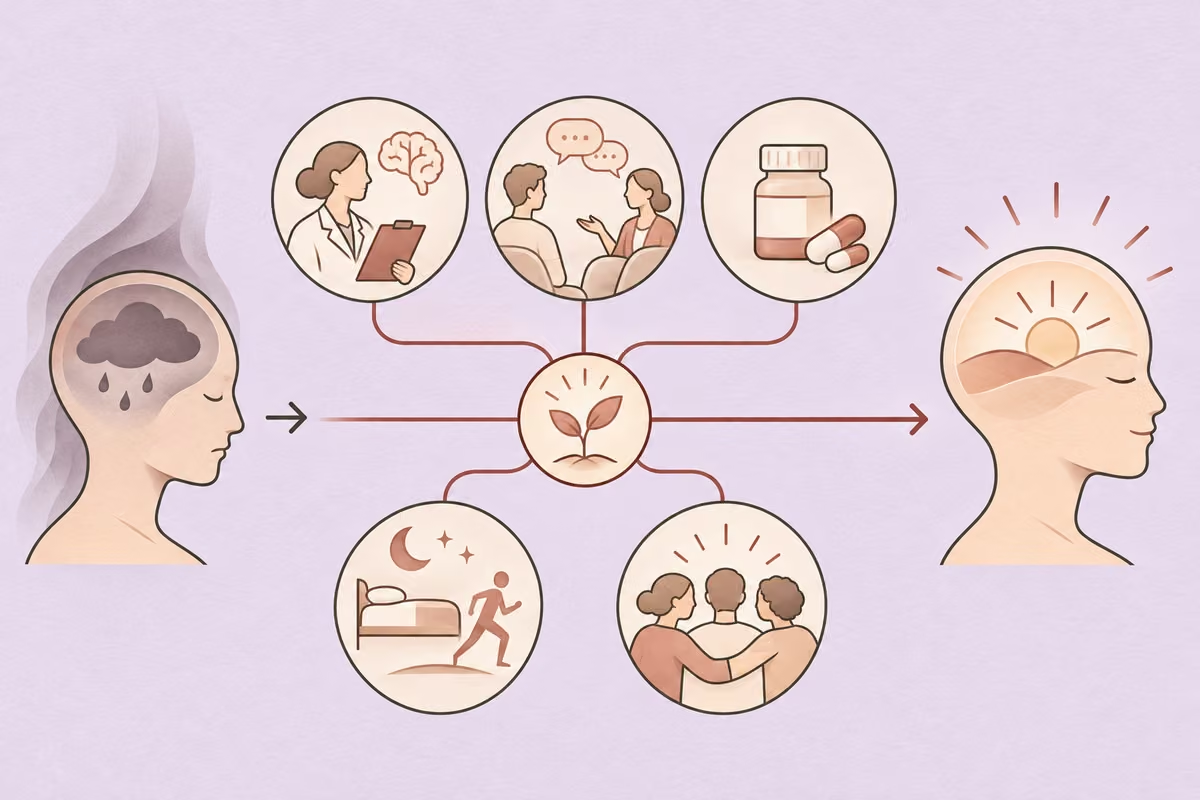
In short: depression responds well to treatment. The main methods are psychotherapy and antidepressants prescribed by a doctor. For mild depression, psychotherapy, behavioural activation and physical activity are often enough. For moderate and severe depression, a combination of psychotherapy and medication is usually recommended. Antidepressants start working after two to four weeks, and they should be continued for at least six months after improvement; they should only be stopped together with a doctor. For severe and treatment-resistant depression, additional methods are used: switching or combining medicines, electroconvulsive therapy, transcranial magnetic stimulation. The diagnosis is made and medication prescribed by a psychiatrist or another qualified doctor.
Which specialist to see
- Psychiatrist — a medical doctor who makes the diagnosis, assesses severity and risks, prescribes and adjusts medication and, if needed, refers to hospital care.
- Psychotherapist — the meaning of this title differs between countries. In some it refers to a doctor with psychiatric training who can both prescribe medication and provide psychotherapy; in others, to a trained therapist who is not a doctor. Check the specialist's qualifications.
- Clinical psychologist — provides psychotherapy and psychological assessment but does not prescribe medication.
- Family doctor or neurologist — often the first to see someone with depression, especially when physical complaints come first. They can rule out physical causes and refer to a psychiatrist.
If you do not know where to start, start with a psychiatrist or your family doctor: they will assess your condition and suggest a plan. In an acute crisis or if you are having thoughts of suicide, contact your local emergency services.
What tests may be ordered
There is no test that confirms depression. But a doctor may order tests to rule out other causes of similar symptoms:
- a complete blood count — to rule out anaemia;
- thyroid hormones;
- blood glucose;
- vitamin B12, folate, ferritin;
- other tests if indicated.
More in "Depression and Physical Illness".
Psychotherapy
Cognitive behavioural therapy
The best-studied method. It helps you notice and change negative thoughts about yourself, the world and the future, overcome avoidance and get active again. Usually 12–20 sessions.
Behavioural activation
Helps you gradually bring back activities that give pleasure and a sense of meaning, even when you "don't feel like it". It is effective on its own: in the COBRA trial by David Richards and colleagues (2016), behavioural activation was no less effective than cognitive behavioural therapy.
Interpersonal therapy
Works with relationships and life events: losses, conflicts, role changes, loneliness. It is effective for depression, including postpartum depression.
Psychodynamic therapy
Helps you understand the deeper causes of depression and recurring patterns in relationships and in how you treat yourself. Short-term psychodynamic therapy has an evidence base for depression.
Mindfulness-based therapy
Mindfulness-based cognitive therapy was developed to prevent repeated episodes. It is especially useful for people who have had depression three or more times.
Other approaches
Acceptance and commitment therapy, schema therapy and systemic family therapy are also used for depression, especially in its chronic forms.
Medication
What to know about antidepressants
- Antidepressants are prescribed only by a doctor. The choice of medicine depends on the symptoms, other illnesses, other medications, previous treatment experience and tolerability.
- The effect is not immediate: the first improvements usually appear after two to four weeks, and the full effect after six to eight weeks.
- In the first weeks there may be side effects, which often pass. Discuss them with your doctor rather than stopping the medicine yourself.
- After improvement, treatment is continued for at least six months to reduce the risk of depression returning. For recurrent depression, longer.
- Stopping abruptly can cause discontinuation symptoms and relapse. Medication is tapered gradually and only together with a doctor.
- Antidepressants are not addictive in the way sedatives or alcohol are, and they do not change your personality.
Why self-treatment is a bad idea
Do not choose antidepressants based on reviews or friends' advice, and do not treat depression with sedatives, sleeping pills or other medicines that a doctor has not prescribed. Some of them are habit-forming, others interact dangerously with antidepressants. Herbal remedies and supplements can also interact with medication — discuss them with your doctor.
What happens if treatment does not help
If two courses of antidepressants at an adequate dose have not helped, the depression is called treatment-resistant. A doctor may:
- reconsider the diagnosis — for example, rule out bipolar disorder or physical illness;
- switch the medicine or add another one;
- intensify psychotherapy;
- offer non-drug treatments.
Electroconvulsive therapy
Electroconvulsive therapy (ECT) is one of the most effective treatments for severe, psychotic and treatment-resistant depression. It is carried out under general anaesthesia with muscle relaxants, so it looks nothing like it does in films. The main side effect is temporary memory problems. It is used in specialised clinics under strict indications.
Transcranial magnetic stimulation
Repetitive transcranial magnetic stimulation (TMS) uses a magnetic field to act on specific areas of the brain. It does not require anaesthesia. It is approved in many countries for depression that has not responded to medication.
Newer methods
New fast-acting medicines have been developed for treatment-resistant depression; they are given only in medical settings under a doctor's supervision. Research into other methods is ongoing.
Hospital treatment
Hospital admission is needed when there is:
- a high risk of suicide;
- severe depression in which the person cannot look after themselves;
- psychotic symptoms;
- a need for complex treatment adjustments.
There are also day hospitals, where a person receives treatment during the day and sleeps at home.
What strengthens the effect of treatment
- Physical activity. A 2024 meta-analysis by Michael Noetel and colleagues showed that walking, running, yoga and strength training noticeably reduce symptoms of depression.
- A regular sleep schedule.
- Support from loved ones — see "How to Help Someone with Depression".
- Cutting out alcohol — see "Depression, Anxiety and Addiction".
- Light therapy — for seasonal depression.
What you can do yourself is described in "How to Get Out of Depression on Your Own".
What clinical guidelines say
The 2022 guideline of the UK National Institute for Health and Care Excellence and national clinical guidelines in other countries agree on the essentials:
- for mild depression — psychotherapy, behavioural activation and physical activity first;
- for moderate and severe depression — psychotherapy and antidepressants, preferably combined;
- suicide risk must always be assessed;
- maintenance treatment after improvement.
How long treatment lasts
- The acute phase — usually 6–12 weeks, until symptoms have reduced significantly.
- Continuation treatment — at least six months after improvement.
- Maintenance treatment for recurrent depression — from a year to several years.
How I can help
In online support for adults, I provide psychotherapy for depression: I help people become active again and work with self-criticism, rumination, guilt and relationships. For moderate and severe depression, I recommend seeing a psychiatrist at the same time; working in tandem usually gives the best result.
Frequently asked questions
Which doctor should I see for depression?
A psychiatrist: they make the diagnosis and prescribe medication if needed. Psychotherapy is also provided by clinical psychologists and psychotherapists. A family doctor or neurologist can rule out physical causes and refer you to a psychiatrist.
Can depression be treated without medication?
For mild depression, psychotherapy, behavioural activation and physical activity are often enough. For moderate and severe depression, medication is usually needed as well. The decision is made together with a doctor.
How long do antidepressants take to work?
The first improvements usually appear after two to four weeks, and the full effect after six to eight weeks. After improvement, treatment continues for at least six months.
Can I stop taking antidepressants on my own?
No. Stopping abruptly can cause discontinuation symptoms and a return of depression. The medicine should be tapered gradually and only together with a doctor.
What if depression treatment is not working?
Discuss it with your doctor. They may reconsider the diagnosis, change or add to the treatment, intensify psychotherapy or offer other methods such as transcranial magnetic stimulation or electroconvulsive therapy.
When should I seek help urgently?
If you have thoughts of suicide or of harming yourself, do not wait for a scheduled appointment: contact your local emergency services or a 24/7 crisis line.
About the author
More than 15 years in psychology and working with people. Degree in psychology from HSE University, four years of training at the Moscow Gestalt Institute, specialisation in long-term therapy of personality disorders and short-term trauma therapy. I provide online support for adults.
Sources
- National Institute for Health and Care Excellence. Depression in adults: treatment and management (NG222). 2022.
- Cipriani A. et al. Comparative efficacy and acceptability of 21 antidepressant drugs for the acute treatment of adults with major depressive disorder. The Lancet, 2018.
- Cuijpers P. et al. A network meta-analysis of the effects of psychotherapies, pharmacotherapies and their combination in the treatment of adult depression. World Psychiatry, 2020.
- Richards D. A. et al. Cost and Outcome of Behavioural Activation versus Cognitive Behavioural Therapy for Depression (COBRA). The Lancet, 2016.
- Noetel M. et al. Effect of exercise for depression: systematic review and network meta-analysis of randomised controlled trials. BMJ, 2024.
- UK ECT Review Group. Efficacy and safety of electroconvulsive therapy in depressive disorders. The Lancet, 2003.
This article is for educational purposes only and does not constitute medical advice, a diagnosis or a treatment recommendation. The symptoms and methods described are meant to help you understand the topic; only a doctor or qualified professional can assess your condition, make a diagnosis and recommend treatment after an individual consultation.