How to Help Someone with Depression Without Burning Out Yourself
How to support someone with depression: what to say and not say, how to help them see a professional, what to do if they refuse help, warning signs of danger, and how to protect your own strength.
Contents
- What to understand about depression
- What to say
- What not to say
- How to listen
- Practical help
- How to help them see a professional
- If they refuse help
- When to act urgently
- Depression in relationships
- If a teenager has depression
- How not to burn out yourself
- How I can help
- Frequently asked questions
- How can I help someone with depression?
- What should you not say to someone with depression?
- What if someone with depression refuses help?
- How should I behave with a partner who has depression?
- How do I avoid burning out while supporting someone with depression?
- When should I seek help urgently?
- About the author
- Sources
In short: the best support for someone with depression is presence, acceptance and help in getting treatment. Listen without judging, do not dismiss their feelings, and avoid advice like "pull yourself together". Concrete actions help: being there, helping with everyday tasks, finding a professional, going to the first appointment together. You cannot cure depression with love or persuasion, but you can make the path to treatment easier. If the person talks about death, ask directly, and if they are in danger, contact your local emergency services. And remember yourself: supporting someone with depression is hard, and you need rest and support too.
What to understand about depression
- Depression is an illness, not laziness, a whim or a weakness of character. A person cannot simply decide to stop feeling it.
- Someone with depression may seem indifferent, irritable or withdrawn. Most often this is a symptom of the illness, not a sign of how they feel about you.
- Depression distorts perception: the person feels they are a burden, that nothing will change, that they are impossible to love.
- Depression is treatable. The main task for those close to them is to help the person get to treatment and not give up on them.
What depression is is explained in detail in "What Is Depression?".
What to say
- "I can see this is hard for you. I'm here."
- "You don't have to pretend everything is fine."
- "I don't fully understand what you're feeling, but I want to."
- "This is not your fault."
- "How can I help?"
- "Let's find a professional together."
What not to say
- "Pull yourself together", "get a grip".
- "Other people have bigger problems."
- "You're just being lazy."
- "Think positive", "smile".
- "It's all in your head."
- "I get sad sometimes too."
Even when said with the best intentions, phrases like these deepen guilt and loneliness.
How to listen
- Choose a calm time and place.
- Ask open questions: "How have you been feeling lately?"
- Listen more than you talk.
- Do not argue with feelings or try to fix them straight away.
- Acknowledge: "That sounds really hard."
- Do not push if the person is not ready to talk. Let them know you are ready to listen whenever they want.
Practical help
In depression, even simple tasks take enormous effort. Concrete help can be worth more than any words:
- cook a meal or bring groceries;
- help with cleaning, paying bills, paperwork;
- invite them for a short walk;
- simply be there, even in silence;
- remind them about a doctor's appointment or medication — gently, without controlling;
- suggest doing something together that they used to enjoy.
Be specific: not "call me if you need anything", but "I'll come over on Saturday — let's go for a half-hour walk".
How to help them see a professional
- Talk about depression as an illness that can be treated, not as "something wrong with your head".
- Offer to help find a psychiatrist or psychotherapist, book an appointment, go together.
- Share information without pressure.
- Explain that seeing a mental health professional is voluntary and confidential.
The types of help available are described in "Depression Treatment".
If they refuse help
- Do not pressure or threaten — this usually increases resistance.
- Find out what is holding them back: shame, fear, distrust, lack of energy, money.
- Suggest a small step: a single consultation, an online session, a conversation with their family doctor.
- Come back to the conversation from time to time.
- An adult cannot be made to get treatment unless their life is in immediate danger. But you can stay close.
When to act urgently
- The person talks about wanting to die or about suicide.
- They say goodbye, give away belongings.
- They look for ways to harm themselves.
- They stop eating and drinking, do not get out of bed.
- Strange ideas, voices or delusions have appeared.
What to do:
- Ask directly whether they are thinking about suicide. Asking does not increase the risk.
- Do not leave the person alone if the danger is immediate.
- Remove dangerous objects and substances from reach.
- Contact your local emergency services or take them to the nearest hospital.
More in "Is Depression Dangerous?".
Depression in relationships
When a partner has depression, it affects the whole couple:
- interest in intimacy and sex drops;
- you do fewer things together;
- irritation and conflicts increase;
- the other partner may feel rejected and lonely.
What helps:
- remembering that these are symptoms of the illness, not a rejection of you;
- talking about what each of you feels and needs;
- keeping small shared rituals;
- seeing a couples or family therapist if needed.
How everyday arguments can wear a couple down is discussed in "Why Couples Fight Over Small Things".
If a teenager has depression
Teenagers often express depression through irritability, withdrawal and problems at school. More in "Depression in Children and Teens".
How not to burn out yourself
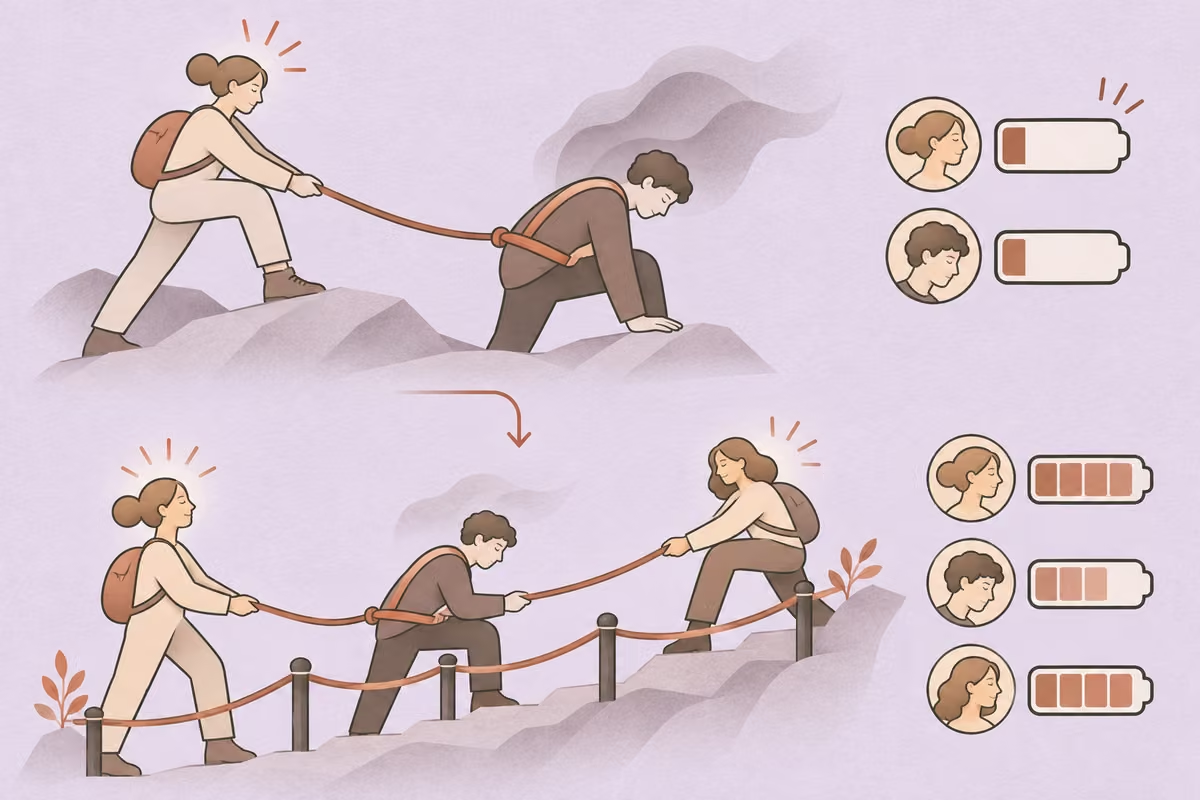
Supporting someone with depression is hard. Research shows that people close to someone with depression often experience stress, anxiety and low mood themselves.
- You cannot cure depression on your own — that is the job of professionals. Your role is support.
- Do not take everything on yourself. Share the caring with several people.
- Keep your own interests, rest and social life.
- Set boundaries: you have the right to be tired and to say "no".
- Do not blame yourself for feeling irritated or exhausted — that is normal.
- Seek support for yourself: from friends, groups for family members, a psychologist.
How I can help
I work not only with people who have depression but also with those close to them: I help them understand what is happening, how to offer support without losing themselves, and how to cope with their own exhaustion, anxiety and guilt.
Frequently asked questions
How can I help someone with depression?
Be there, listen without judging, help with concrete tasks and support them in seeing a professional. Do not pressure them or dismiss their feelings with phrases like "pull yourself together".
What should you not say to someone with depression?
Avoid "pull yourself together", "others have it worse", "you're just lazy", "think positive". These phrases deepen guilt and loneliness. It is better to say: "I can see this is hard for you. I'm here."
What if someone with depression refuses help?
Do not pressure them; find out what is holding them back, suggest a small step such as a single consultation, and return to the conversation from time to time. If their life is in immediate danger, contact your local emergency services.
How should I behave with a partner who has depression?
Remember that withdrawal and irritability are symptoms of the illness, not a rejection of you; talk about both partners' feelings and needs, keep small shared rituals, and see a couples therapist if needed.
How do I avoid burning out while supporting someone with depression?
Do not carry all the responsibility alone, share the caring, keep time for rest and your own interests, set boundaries and seek support for yourself.
When should I seek help urgently?
If the person talks about suicide, is looking for ways to harm themselves or cannot be kept safe, do not wait: contact your local emergency services or a 24/7 crisis line.
About the author
More than 15 years in psychology and working with people. Degree in psychology from HSE University, four years of training at the Moscow Gestalt Institute, specialisation in long-term therapy of personality disorders and short-term trauma therapy. I provide online support for adults.
Sources
- National Institute of Mental Health. Depression: what you need to know. 2024.
- Royal College of Psychiatrists. Depression: information for carers and relatives. 2023.
- Dazzi T. et al. Does asking about suicide and related behaviours induce suicidal ideation? What is the evidence? Psychological Medicine, 2014.
- van Wijngaarden B., Schene A. H., Koeter M. W. J. Family caregiving in depression: impact on caregivers' daily life, distress, and help seeking. Journal of Affective Disorders, 2004.
- Whisman M. A. Marital distress and DSM-IV psychiatric disorders in a population-based national survey. Journal of Abnormal Psychology, 2007.
- World Health Organization. Depressive disorder (depression). Fact sheet, 2023.
This article is for educational purposes only and does not constitute medical advice, a diagnosis or a treatment recommendation. The symptoms and methods described are meant to help you understand the topic; only a doctor or qualified professional can assess your condition, make a diagnosis and recommend treatment after an individual consultation.