Depression in Women, Men and Older Adults: How It Differs
Why women get depressed more often and men seek help less, how male depression shows up, how menopause and hormones affect mood, and why depression in older adults is mistaken for ageing or dementia.
Contents
- Depression in women
- Why women are affected more often
- Special periods
- Depression during menopause
- How it shows up
- Depression in men
- How male depression shows up
- Why men seek help less often
- A high risk of suicide
- Testosterone and mood
- Depression in older adults
- Why it often goes unnoticed
- How it shows up
- Causes
- Depression and dementia
- How it is assessed
- What helps
- Depression in midlife
- What all groups have in common
- How I can help
- Frequently asked questions
- Why are women more likely to be depressed?
- What does depression look like in men?
- Can menopause cause depression?
- How do you tell depression from dementia in older adults?
- Can depression be treated in older age?
- When should I seek help urgently?
- About the author
- Sources
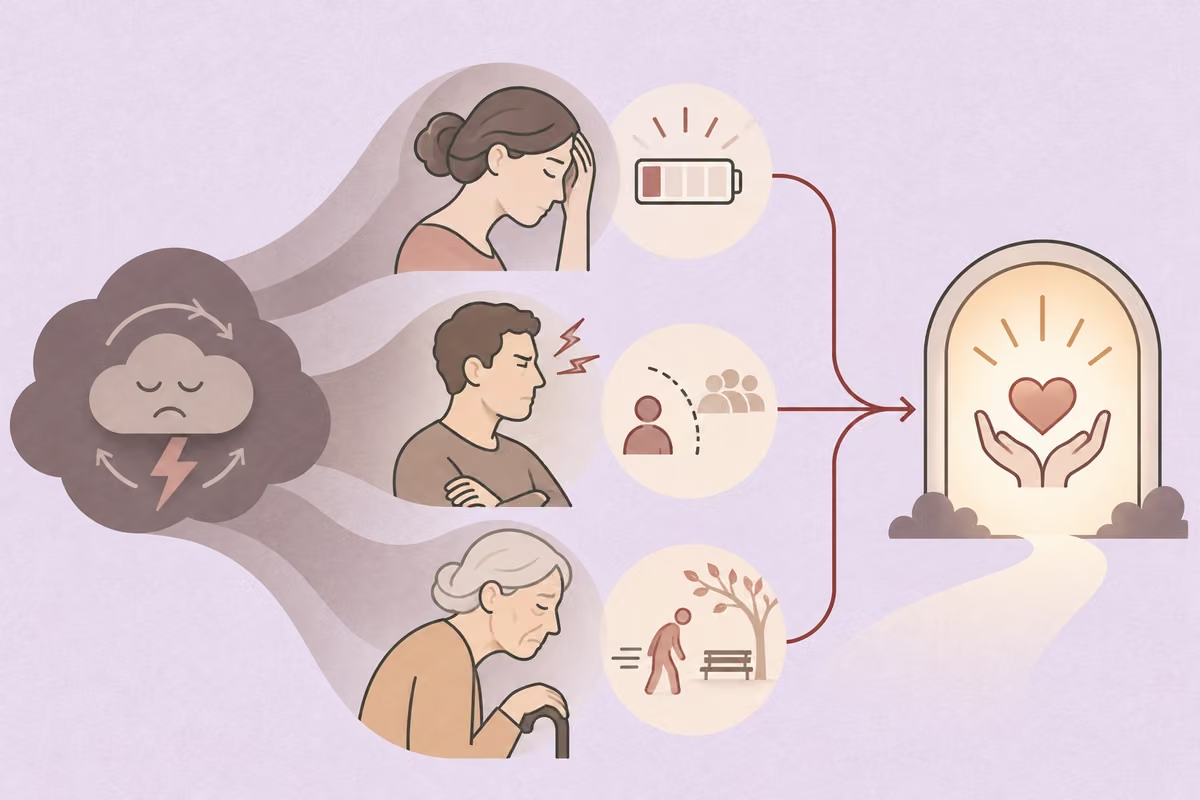
In short: anyone can get depression, but it shows up differently. Women are diagnosed with depression roughly one and a half to two times as often as men. Hormonal transitions play a part — adolescence, pregnancy, childbirth, perimenopause — as do social pressures and experiences of violence. Men talk about sadness less and more often express depression through irritability, anger, overwork, alcohol and risky behaviour; they seek help less often and die by suicide more often. In older adults, depression is often mistaken for "normal ageing" or dementia, even though it responds to treatment just as well. In every group, depression is an illness, not weakness, age or personality.
Depression in women
Why women are affected more often
According to the WHO and large epidemiological studies, depression is roughly one and a half to two times more common in women than in men. The gap appears in adolescence. The reasons include:
- Hormonal fluctuations. The brain's sensitivity to changes in oestrogen and progesterone raises the risk of depression at certain points in life.
- A double load: work, home, caring for children and ageing parents.
- A higher rate of experiencing violence, including in childhood.
- A tendency to ruminate: research by Susan Nolen-Hoeksema showed that women, on average, more often go over distressing thoughts again and again.
- Social expectations and inequality.
Part of the gap may also be explained by men being less likely to admit to depression and to seek help.
Special periods
- Premenstrual mood changes, including a severe form, premenstrual dysphoric disorder.
- Pregnancy and the period after childbirth.
- Perimenopause and menopause.
Depression during menopause
Perimenopause — the transition lasting several years before the last period — is linked to a higher risk of depression, even in women who have never been depressed before. This is related to fluctuating and falling oestrogen levels, as well as hot flushes, poor sleep, bodily changes and life transitions. If low mood, irritability, sleep problems or anxiety last for weeks, it is worth seeing a gynaecologist and a psychotherapist or psychiatrist. Treatment is chosen by a doctor.
How it shows up
Compared with men, women more often experience low mood, tearfulness, guilt, anxiety, and changes in sleep and appetite, including increased appetite, sleepiness and other features of atypical depression, described in "Types of Depression".
Depression in men
How male depression shows up
Many men do not recognise depression in themselves because it does not look the way they expect. Instead of sadness there is more often:
- irritability, angry outbursts, aggression;
- throwing themselves into work, workaholism;
- drinking or using other substances;
- risky behaviour — dangerous driving, gambling, conflicts;
- physical complaints: fatigue, pain, stomach problems, poor sleep;
- reduced interest in sex and erection problems;
- emotional shutdown, a sense of emptiness.
Why men seek help less often
- The belief that a man should cope on his own and not show weakness.
- Shame and fear of being judged.
- A habit of not noticing or naming their feelings.
A high risk of suicide
According to the WHO, men die by suicide considerably more often than women, even though they are diagnosed with depression less often. This is one of the reasons it is so important to recognise depression in men.
Testosterone and mood
A marked drop in testosterone can come with low mood, fatigue and reduced libido. It is diagnosed and treated by a doctor — an endocrinologist or urologist. Do not take hormonal drugs on your own.
Depression in older adults
Why it often goes unnoticed
- Older people and their families often consider low mood, fatigue and loss of interest "normal for their age".
- Older people talk about sadness less and complain more about physical symptoms, sleep and memory.
- Symptoms of depression overlap with symptoms of chronic illnesses.
How it shows up
- Loss of interest, apathy.
- Fatigue, poor sleep.
- Physical complaints, pain.
- Anxiety, worry about health.
- Problems with memory and concentration.
- Withdrawing from others, isolation.
- Loss of appetite and weight.
- A feeling of being a burden.
Causes
- Chronic illness and pain — see "Depression and Physical Illness".
- Losses: the death of a spouse and friends, retirement, losing former roles.
- Loneliness and isolation.
- Reduced mobility and independence.
- Changes in the small blood vessels of the brain, so-called vascular depression.
- Side effects of medication.
Depression and dementia
- Depression in older adults can cause noticeable problems with memory and thinking that resemble dementia. This used to be called pseudodementia. An important difference: memory often improves when the depression is treated.
- Depression appearing for the first time in later life can be an early sign of dementia and raises its risk.
- Depression is also common in people who already have dementia.
Only a doctor — a psychiatrist, neurologist or geriatrician — can tell one from the other.
How it is assessed
A dedicated questionnaire, the Geriatric Depression Scale, has been developed for older adults.
What helps
- Depression in older adults responds well to treatment: psychotherapy, and medication chosen by a doctor with other illnesses and medicines in mind.
- Physical activity adapted to the person's abilities.
- Social contact, taking part in family and community life, meaningful activities.
- Treating chronic illness and pain.
Depression in midlife
Midlife often comes with a heavy load: career, teenage children, ageing parents, the first health problems. Sometimes rethinking one's life comes with low mood, often called a midlife crisis. If it lasts for weeks and gets in the way of life, it is a reason to see a professional.
What all groups have in common
In every group:
- the core symptoms of depression are essentially the same;
- depression is treatable;
- the earlier treatment starts, the better the outcome.
If you are not sure whether what you feel is depression, "Depression or Something Else?" may help you sort it out.
How I can help
In online support for adults, I work with women and men of different ages. Men often need to find words for what they are going through and stop seeing it as weakness; women often need to reduce their load and self-criticism; older people often need to cope with losses and find new sources of meaning. With marked depression, I recommend seeing a psychiatrist at the same time.
Frequently asked questions
Why are women more likely to be depressed?
Hormonal transitions — adolescence, pregnancy, childbirth, perimenopause — a double load, more frequent experience of violence, a tendency to ruminate and social factors all play a part. Part of the gap may come from men being less likely to admit to depression.
What does depression look like in men?
In men, depression more often shows up as irritability, anger, overwork, alcohol, risky behaviour and physical complaints rather than sadness. That is why it often goes unrecognised.
Can menopause cause depression?
Yes. Perimenopause is linked to a higher risk of depression because of fluctuating oestrogen levels, poor sleep and life changes. If low mood lasts for weeks, see a gynaecologist and a mental health professional.
How do you tell depression from dementia in older adults?
In depression, memory problems often ease when the depression is treated; in dementia they progress. But depression can also be an early sign of dementia. Only a doctor can tell them apart.
Can depression be treated in older age?
Yes. Depression in older adults responds to treatment just as it does in younger people. Psychotherapy, medication chosen by a doctor with other illnesses in mind, physical activity and social contact help most people.
When should I seek help urgently?
If you or someone close to you has thoughts of suicide or of self-harm, do not wait: contact your local emergency services or a 24/7 crisis line.
About the author
More than 15 years in psychology and working with people. Degree in psychology from HSE University, four years of training at the Moscow Gestalt Institute, specialisation in long-term therapy of personality disorders and short-term trauma therapy. I provide online support for adults.
Sources
- Salk R. H., Hyde J. S., Abramson L. Y. Gender differences in depression in representative national samples: meta-analyses of diagnoses and symptoms. Psychological Bulletin, 2017.
- Kuehner C. Why is depression more common among women than among men? The Lancet Psychiatry, 2017.
- Martin L. A., Neighbors H. W., Griffith D. M. The experience of symptoms of depression in men vs women: analysis of the National Comorbidity Survey Replication. JAMA Psychiatry, 2013.
- Freeman E. W. et al. Associations of hormones and menopausal status with depressed mood in women with no history of depression. Archives of General Psychiatry, 2006.
- Alexopoulos G. S. Depression in the elderly. The Lancet, 2005.
- Byers A. L., Yaffe K. Depression and risk of developing dementia. Nature Reviews Neurology, 2011.
- World Health Organization. Suicide. Fact sheet, 2024.
This article is for educational purposes only and does not constitute medical advice, a diagnosis or a treatment recommendation. The symptoms and methods described are meant to help you understand the topic; only a doctor or qualified professional can assess your condition, make a diagnosis and recommend treatment after an individual consultation.